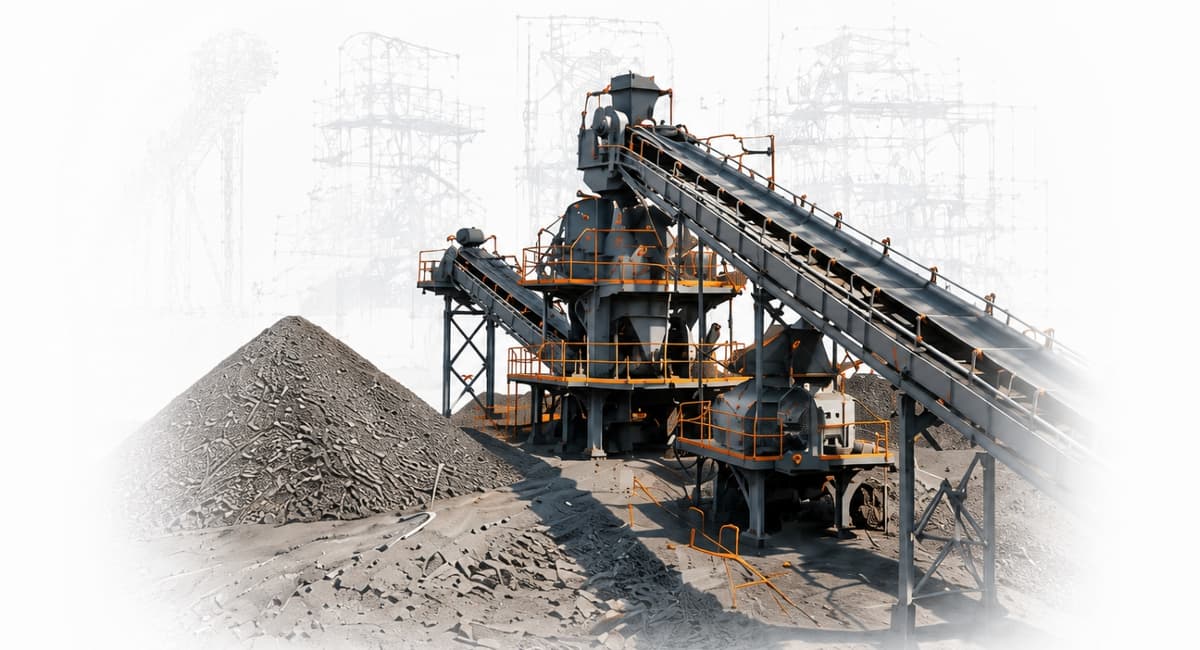
A VSI crusher is a high-speed impact crushing machine used for fine crushing, aggregate shaping and manufactured sand production. VSI stands for Vertical Shaft Impactor, describing the machine's vertical shaft and rotor arrangement.
Unlike a jaw crusher or cone crusher, which mainly reduce material through compression, a VSI crusher uses high-speed impact. Material is accelerated by a rotating rotor and then thrown against other particles or impact surfaces inside the crushing chamber. This action not only reduces particle size but can also improve the shape of the final product.
Because of this, a vertical shaft impactor crusher is commonly used in the later stages of crushing plants, particularly where cubical aggregates, controlled fines or manufactured sand are required.
In a typical circuit, a jaw crusher may perform primary crushing, followed by a cone crusher for further reduction. A VSI crusher can then be used for final shaping and fine crushing before screening.
This guide explains what a VSI crusher is, how it works, its main configurations, applications, maintenance requirements and the factors that influence VSI crusher price.
What Is a VSI Crusher?
A VSI crusher or vertical shaft impact crusher, is designed to crush and reshape material through high-velocity impact.
Feed material enters the machine through the top and moves toward a rapidly rotating rotor. The rotor accelerates the material outward using centrifugal force. Once the material leaves the rotor, it enters the crushing chamber at high velocity.
Depending on the VSI configuration, the particles may collide with other particles, a rock bed or stationary metal impact surfaces. These impacts fracture the material and can also improve particle shape.
This makes a VSI crusher machine different from equipment selected only for conventional size reduction. In many applications, the objective is not simply to produce smaller material but to achieve a specific particle shape and gradation.
VSI technology is therefore widely associated with aggregate shaping, manufactured sand and tertiary or quaternary crushing.
How Does a VSI Crusher Work?
The VSI crusher working principle is based on controlled high-speed acceleration followed by impact.
First, the feed enters the centre of the rotor. As the rotor rotates, centrifugal force moves the material toward its outer edge and accelerates it to high velocity.
The material then leaves the rotor and enters the crushing chamber. Depending on the machine configuration, it may strike a rock bed, anvils or other impact surfaces. Particle-to-particle collisions can also contribute to the crushing process.
The basic process is:
Feed Material → Rotor → High-Speed Acceleration → Impact → Crushing & Shaping → Discharge
The amount of impact energy depends on factors such as rotor speed and material characteristics. However, maximum rotor speed does not automatically mean maximum performance. Rotor speed, feed rate, feed size, material abrasiveness and the desired product all need to be considered together.
The final product is then discharged from the crusher and can be sent to a vibrating screen for classification. Oversized material may be recirculated through the circuit when the plant design requires it.
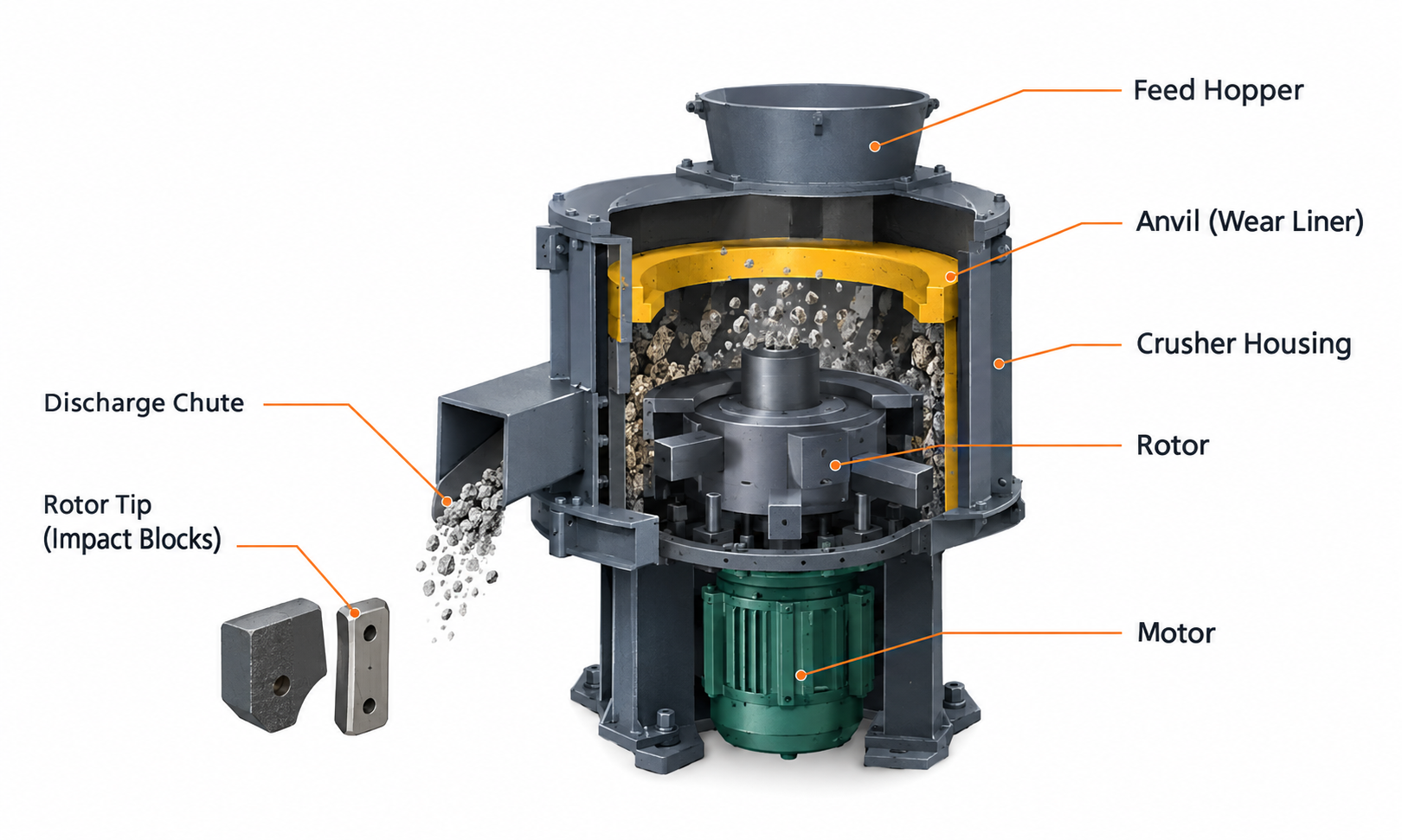
Main Components of a VSI Crusher
The design of a VSI crusher machine centres around its high-speed rotor and vertical shaft.
The rotor receives the feed material and accelerates it toward the crushing chamber. Rotor condition and balance are important because the assembly operates at high speed.
The vertical shaft transfers power to the rotor and supports the rotating assembly. Proper alignment and maintenance are essential for reliable operation.
The crushing chamber provides the environment in which high-speed impact takes place. Its internal configuration varies depending on whether the machine uses rock-on-rock, rock-on-anvil or another impact arrangement.
Wear components such as rotor tips, shoes, anvils and rock shelves are exposed to continuous impact and abrasion. Their condition can influence product quality, operating efficiency and machine balance.
Types of VSI Crushers
VSI crushers are commonly differentiated by their impact configuration rather than being completely different categories of machines. The main arrangements are rock-on-rock, rock-on-anvil and shoe-on-anvil.
Rock-on-Rock VSI Crusher
In a rock-on-rock configuration, material accelerated by the rotor impacts against a bed of material within the crushing chamber.
Rather than relying primarily on direct contact with metal surfaces, the material helps shape the impact zone. This configuration can be useful for applications involving abrasive materials and aggregate shaping.
However, rock-on-rock operation does not eliminate wear. Rotor components and other internal parts still experience abrasion and require regular inspection.
Rock-on-Anvil VSI Crusher
A rock-on-anvil configuration directs high-speed material against stationary wear-resistant anvils.
The direct impact between the material and anvils creates strong crushing action and can be useful where additional size reduction and fine material production are required.
Since the material repeatedly strikes the anvil surfaces, wear-part condition is an important consideration when selecting and operating this type of VSI.
Shoe-on-Anvil VSI Crusher
In a shoe-on-anvil arrangement, the rotor uses wear-resistant shoes to accelerate material toward stationary anvils.
The exact design differs between manufacturers, but the basic principle remains the same: the rotor accelerates the feed and controlled impact produces crushing and shaping.
The most suitable configuration depends on factors such as feed material, abrasiveness, feed size, capacity and the required final product.
VSI Crusher for Manufactured Sand and M-Sand Production
One of the most important applications of a vertical shaft impactor is manufactured sand production.
M-sand is produced by processing suitable rock into fine aggregate for construction applications. A VSI can be used in this process because its impact action helps break and reshape particles, producing a controlled fine fraction suitable for further screening or classification.
A VSI crusher plant for sand production typically works as part of a larger processing circuit rather than as a standalone machine. Depending on the application, the circuit may include feeders, primary and secondary crushers, vibrating screens, conveyors and additional classification or washing equipment.
The quality of VSI sand depends on more than the crusher itself. Feed material, moisture, gradation, rotor configuration, operating conditions and screening efficiency can all influence the final product.
For this reason, manufactured sand production should be designed around the complete processing requirement rather than selecting a VSI based only on its capacity.
Where Does a VSI Crusher Fit in a Crushing Plant?
A VSI is generally positioned toward the later stages of a crushing circuit.
A typical aggregate processing flow may look like this:
Raw Material → Primary Crushing → Secondary Crushing → Screening → VSI Crushing → Final Screening → Finished Aggregate / Manufactured Sand
The jaw crusher may handle large feed material during primary crushing. A cone crusher can then perform secondary or tertiary size reduction. The VSI can subsequently provide additional crushing and particle shaping.
This arrangement allows each machine to perform the task it is best suited for.
The exact position of a VSI depends on the feed size, required product, plant capacity and material characteristics. Some circuits may use the VSI for aggregate shaping, while others may use it primarily for manufactured sand production.
Applications of VSI Crushers
A VSI crusher machine is used across several material-processing industries.
In aggregate production, VSI crushing is commonly used when improved particle shape is required. More cubical particles can be desirable for applications involving concrete, asphalt and road construction.
Quarries may use VSI equipment during tertiary or quaternary crushing when further shaping or fine crushing is required after conventional size reduction.
Manufactured sand production is another major application. A VSI can process suitable crushed rock into fine aggregate for construction use.
VSI technology can also be considered for selected mining, mineral-processing and recycling applications where the feed characteristics and required product are suitable for high-speed impact crushing.
Advantages of Using a VSI Crusher
The biggest advantage of a VSI is its ability to combine size reduction with particle shaping.
High-speed impact can help produce cubical particles and reduce undesirable elongated or flaky shapes. This makes VSI crushing particularly valuable when aggregate shape is an important quality requirement.
A VSI can also generate fine material efficiently in suitable applications, making it useful in manufactured sand production.
Another advantage is configuration flexibility. Rock-on-rock and anvil-based arrangements allow the crushing action to be adapted to different materials and product requirements.
A VSI also complements conventional crushers. Rather than replacing jaw or cone crushers, it often performs a specialized role in the later stages of the crushing circuit.
Factors to Consider When Choosing a VSI Crusher Machine
Selecting the right VSI crusher machine requires more than comparing production capacity.
The first consideration is the feed material. Hardness, abrasiveness, moisture and particle characteristics affect both crushing performance and wear.
Feed size is another important factor. The material entering the VSI should be suitable for the machine's designed operating range.
The required final product should also guide the selection. A plant focused on cubical aggregate may have different requirements from a plant producing manufactured sand.
Rotor configuration, motor power, expected production, wear-part requirements, maintenance accessibility and integration with existing equipment should all be evaluated.
Most importantly, the VSI should be selected as part of the complete plant. Feeders, crushers, vibrating screens, conveyors and recirculation arrangements can all affect the machine's actual performance.
What Affects VSI Crusher Price?
VSI crusher price varies according to machine capacity, rotor configuration, motor power, automation, wear-part specifications and supporting equipment.
There is also an important difference between purchasing an individual VSI crusher and investing in a complete VSI crusher plant. A complete plant may include feeders, conveyors, vibrating screens, electrical systems and other auxiliary equipment.
Buyers should therefore look beyond the initial purchase price. Wear-part consumption, energy requirements, maintenance needs, production capacity and final product quality can have a significant effect on the overall operating economics.
The right VSI is not necessarily the cheapest machine. It is the machine configuration that can deliver the required product consistently under the actual operating conditions.
How to Choose a VSI Crusher Manufacturer
Choosing the right VSI crusher manufacturer is an important part of the equipment-selection process.
A capable manufacturer should first understand the application, including feed material, feed size, required capacity, final product specifications and the existing crushing circuit.
Technical support is another important consideration. Availability of wear parts, maintenance assistance and after-sales support can influence the long-term reliability of the equipment.
Rather than selecting a machine solely on purchase price, buyers should evaluate the manufacturer's engineering approach, equipment suitability and ability to support the complete material-processing requirement.
Why Choose Pithal Machine for VSI Crushing Solutions?
Pithal Machine focuses on application-oriented crushing solutions for material-processing requirements. For VSI applications, the right machine needs to be considered alongside factors such as feed characteristics, production targets, product specifications and downstream screening.
A VSI can perform an important role in aggregate shaping, fine crushing and manufactured sand production but its performance is closely connected to the rest of the crushing circuit.
Pithal Machine's equipment portfolio includes solutions for different stages of crushing and screening. Depending on the application, equipment such as jaw crushers, cone crushers, VSI crushers and vibrating screens can form part of a complete material-processing setup.
For customers evaluating a VSI solution, the starting point should be the application itself: what material needs to be processed, what output is required and how the VSI will fit into the existing or planned plant.
Final Thoughts
A VSI crusher has a specialized role in modern crushing and screening operations. Instead of relying primarily on compression, it uses high-speed impact to reduce and reshape material.
This makes the vertical shaft impactor crusher particularly useful for aggregate shaping, fine crushing, tertiary and quaternary applications and manufactured sand production.
Its performance depends on several factors, including feed material, rotor configuration, operating conditions, wear condition and the design of the surrounding crushing and screening circuit.
For aggregate producers and sand manufacturers, a properly selected VSI crusher plant can provide an effective way to produce cubical aggregates and manufactured sand. Evaluating the complete application rather than focusing only on VSI crusher price can lead to a more practical long-term equipment decision.