
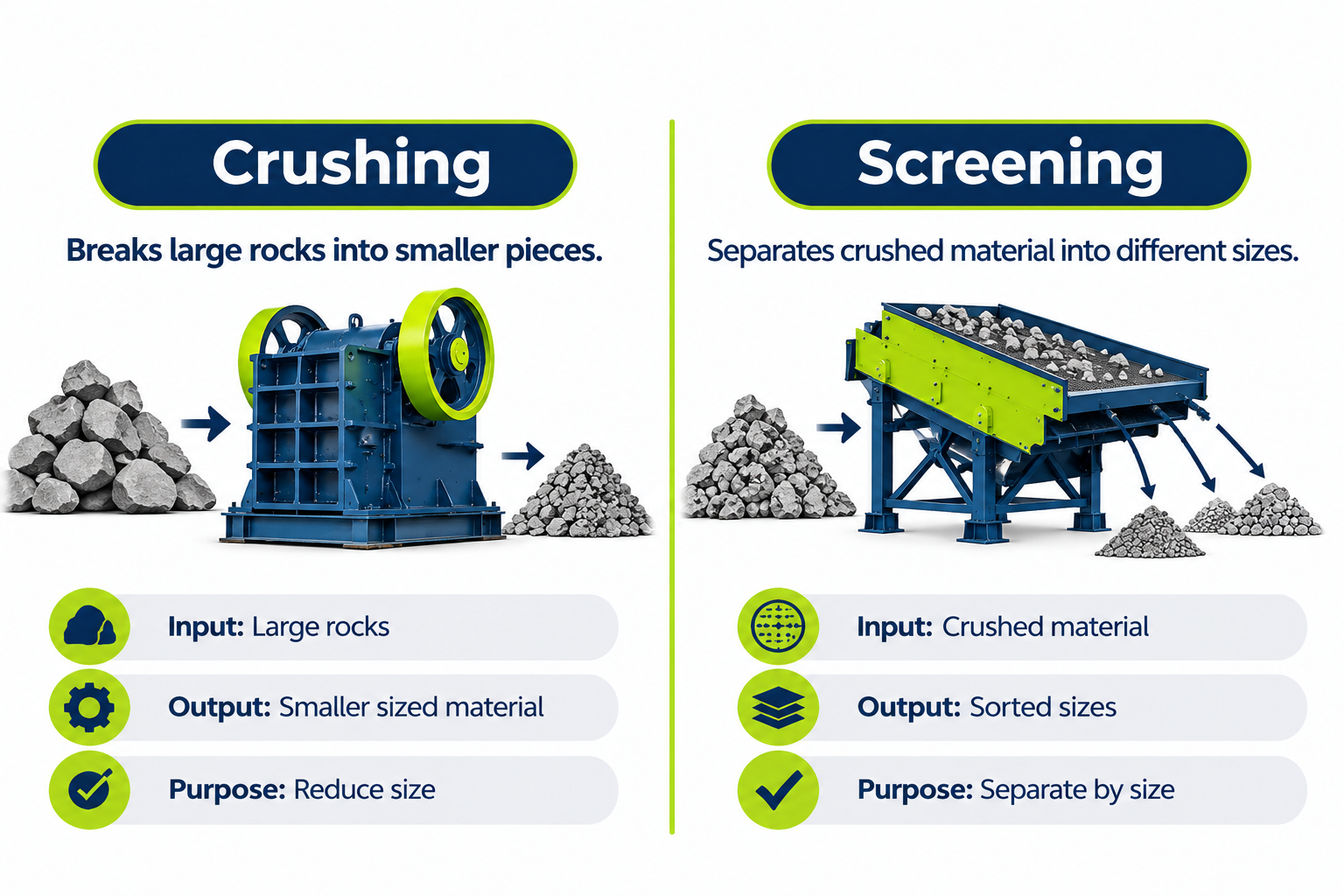
Crushing and screening are two essential processes in the mining, quarrying and construction industries. Both play an important role in converting raw materials into usable aggregates but they perform different functions. Crushing reduces large rocks into smaller particles, while screening separates these particles into different sizes.
In a stone crushing and screening plant, both operations work together to produce aggregates that meet specific construction requirements. Understanding the difference between crushing and screening helps plant operators, contractors and construction businesses select suitable equipment, improve production efficiency and maintain consistent material quality.
Let's explore how these processes work, the equipment involved and their importance in aggregate production.
What Is Crushing?
Crushing is the process of reducing large rocks, stones and other raw materials into smaller particles using mechanical force. It is commonly performed in mining, quarrying and aggregate processing plants to prepare materials for construction and further processing.
The main purpose of crushing is to reduce the size of raw materials to meet specific production requirements. Depending on the required output, the process may involve primary, secondary and tertiary crushing stages.
How Does the Crushing Process Work?
The crushing process begins when raw materials are fed into a crusher through a vibrating feeder or similar feeding system. The machine applies compression, impact or mechanical force to break the rocks into smaller pieces.
Different crushers operate using different principles. A jaw crusher uses compressive force between fixed and movable jaw plates, while a cone crusher reduces material through compression between its mantle and concave. Impact crushers use high-speed impact to break rocks into smaller particles.
After crushing, the material is transported through conveyor belts for screening or further size reduction.
What Are the Different Stages of Crushing?
Primary Crushing: This is the first stage, where large rocks and boulders are reduced into manageable sizes. Jaw crushers and gyratory crushers are commonly used for primary crushing.
Secondary Crushing: The material from primary crushing is further reduced to achieve smaller aggregate sizes. Cone crushers and impact crushers are commonly used at this stage.
Tertiary Crushing: This stage produces finer aggregates and helps achieve the required particle size and shape. Cone crushers and VSI crushers are commonly used depending on the application.
Types of Crushing Equipment
Different types of stone crushers are selected according to material hardness, feed size, production capacity and final output requirements.
Jaw Crusher: Primarily used for crushing large and hard materials such as granite, basalt and limestone.
Cone Crusher: Suitable for secondary and tertiary crushing, particularly when processing hard and abrasive materials.
Impact Crusher: Uses impact force to break medium-hard and softer materials into smaller particles.
VSI Crusher: Uses high-speed rotor action to produce cubical aggregates and manufactured sand.
What Is Screening?
Screening is the process of separating crushed materials into different size categories using specialised screening equipment. It helps classify aggregates according to their particle dimensions so that the final material meets specific construction and industrial requirements.
Unlike crushing, screening does not primarily reduce the size of rocks. Instead, it separates particles into different grades, such as fine aggregates, coarse aggregates and manufactured sand.
How Does the Screening Process Work?
The screening process generally involves feeding material onto a vibrating screen fitted with mesh openings of different sizes.
As the screen vibrates, smaller particles pass through the openings, while larger particles move across the screening surface towards the discharge end. Multi-deck vibrating screens can separate materials into several size categories simultaneously.
For example, a multi-deck screen may separate crushed aggregates into 10 mm, 20 mm and 40 mm sizes, depending on its configuration and mesh arrangement.
Oversized material can be redirected to the crusher for further processing through a closed-circuit crushing and screening system.
What Is Pre-Screening in a Crushing Plant?
Pre-screening is the process of separating fine materials and unwanted particles before they enter the primary crusher. It is commonly performed using grizzly feeders or screening equipment installed ahead of the crusher.
This process prevents already-sized material from undergoing unnecessary crushing. It can reduce the load on the primary crusher, improve material handling and support better plant efficiency.
Types of Screening Equipment
Vibrating Screen: Uses mechanical vibration to separate aggregates according to particle size. It is widely used in stone crusher plants and mining operations.
Inclined Screen: Features an angled screening surface that allows materials to move across the deck during the separation process.
Horizontal Screen: Uses a nearly level screening surface and is suitable for applications requiring accurate aggregate sizing.
Multi-Deck Screen: Contains multiple screening surfaces with different mesh sizes, enabling the production of several aggregate grades in a single operation.
What Is the Difference Between Crushing and Screening?
The main difference between crushing and screening is their purpose. Crushing physically reduces the size of raw materials, whereas screening separates the processed material into different size ranges.
Both processes are necessary for efficient aggregate production, but their functions and equipment requirements differ.
Differences Between Crushing and Screening
How Do Crushing and Screening Work Together?
Crushing and screening are integrated into a single material processing system to produce aggregates of the required sizes.
In a typical crushing and screening plant, raw materials first pass through a feeder and may undergo pre-screening before entering the primary crusher. The crushed material is then transferred to a vibrating screen, where it is separated into different sizes.
Materials that meet the required specifications are discharged as finished aggregates. Oversized particles are returned to the crusher for additional size reduction. This arrangement is known as closed-circuit crushing.
Combining these operations helps maintain consistent aggregate grading, reduce unnecessary material handling and improve production efficiency.
Applications of Crushing and Screening
Crushing and screening equipment is used across industries that require raw materials to be reduced and classified into specific sizes.
Construction and Infrastructure: Produces aggregates used in concrete, building foundations, bridges and infrastructure development.
Road Construction: Processes crushed stone into graded aggregates for road bases, sub-bases and asphalt applications.
Mining Operations: Reduces extracted ores into smaller particles and separates materials for subsequent processing.
Quarrying: Converts extracted rocks into different aggregate sizes for construction and commercial applications.
Manufactured Sand Production: Uses crushing equipment, particularly VSI crushers, to produce manufactured sand. Screening helps separate the finished material according to required particle sizes.
How to Choose the Right Crushing and Screening Equipment?
Selecting suitable crushing and screening equipment depends on the material being processed, production capacity and final aggregate requirements.
Consider these important factors before investing in a crushing and screening plant.
Material Characteristics: Consider the hardness, abrasiveness, moisture content and composition of the raw material when selecting crushers and screens.
Feed Size and Output Requirements: The size of incoming material and the desired final aggregate sizes determine the crushing stages and screening configuration.
Production Capacity: Select equipment that can handle the required tonnes per hour without creating bottlenecks in the production line.
Screening Accuracy: Choose suitable screen mesh sizes and deck configurations to produce aggregates with the required grading.
Plant Configuration: Consider whether a stationary or mobile crushing and screening plant better suits the project location, production requirements and material transportation needs.
Working with an experienced crushing plant manufacturer can help businesses identify suitable machinery and develop an efficient material processing setup.
Conclusion
Crushing and screening perform different but equally important functions in aggregate production. Crushing reduces large rocks into smaller particles, while screening classifies those particles into specific sizes for construction, mining and infrastructure applications.
Selecting the right combination of crushing and screening equipment helps improve production efficiency, maintain consistent aggregate grading and reduce unnecessary material processing.
Pithal Machines provides crushing and screening equipment solutions for material processing requirements across different industries. Choosing a suitable plant configuration can help businesses establish an efficient production line and meet their aggregate requirements.