
Choosing the right crushing equipment is important for maintaining production efficiency, controlling operating costs and achieving the required material size. In mining, quarrying and aggregate processing, different crushers are designed to handle specific feed sizes and production requirements.
Gyratory crushers and cone crushers are two commonly used machines that reduce rocks through compression. Although they share a similar crushing principle, their construction, capacity and applications differ. Gyratory crushers are generally used for high-capacity primary crushing, while cone crushers are widely used for secondary and tertiary size reduction.
Understanding the difference between a gyratory crusher and a cone crusher helps mining companies, quarry operators and contractors select equipment that matches their material characteristics and production targets.
What Is a Gyratory Crusher?
A gyratory crusher is a heavy-duty crushing machine primarily used to reduce large rocks during the initial stage of material processing. It is commonly installed in large mining operations and mineral processing plants where high production capacity is required.
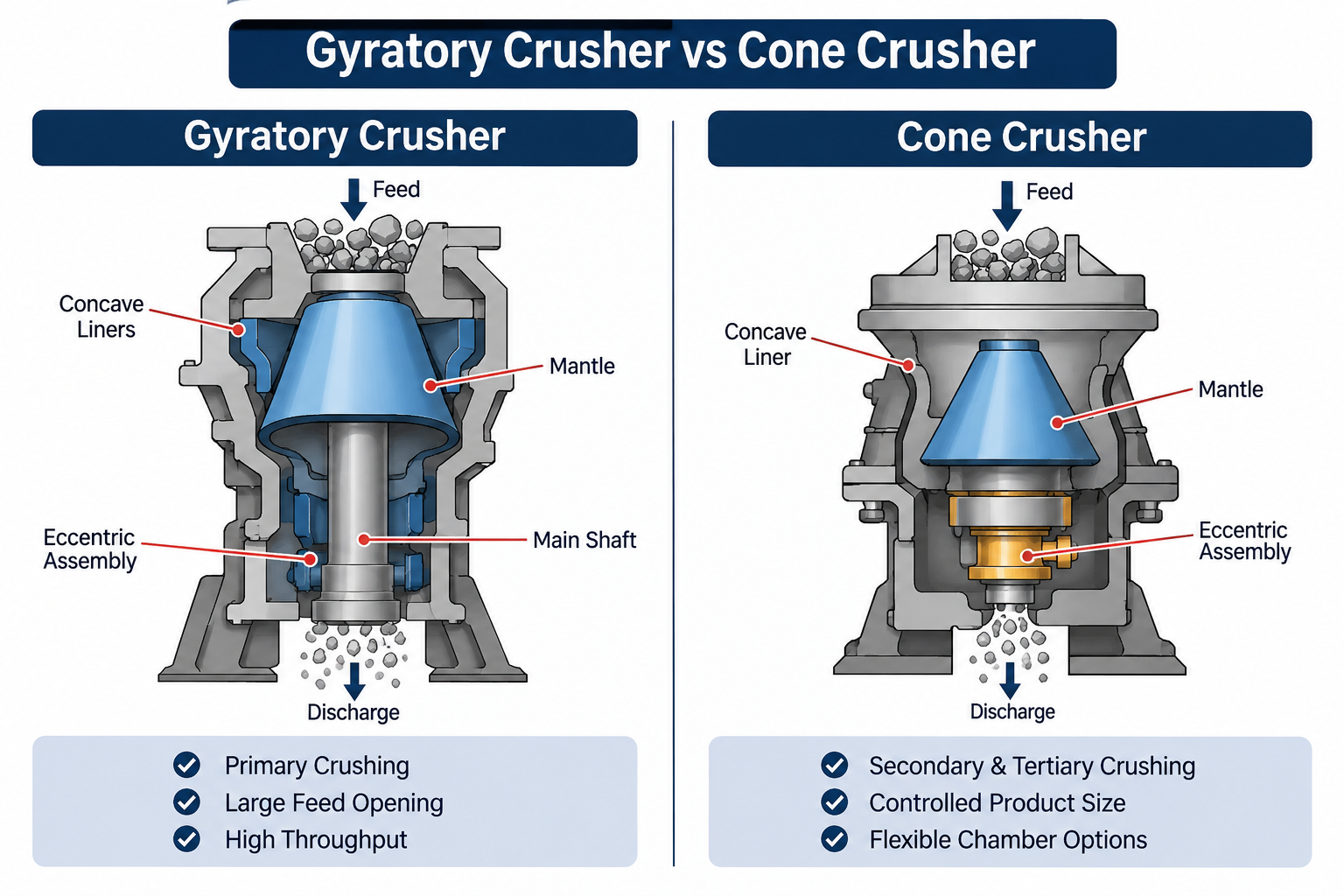
The machine consists of a stationary outer shell fitted with concave liners and a moving crushing head covered by a mantle. An eccentric mechanism moves the crushing head in a gyrating motion, compressing rocks between the mantle and concave surfaces.
Its large feed opening allows it to accept oversized material from mining and excavation activities. This makes the gyratory crusher suitable for operations that need to process substantial quantities of large rocks continuously.
What Is a Cone Crusher?
A cone crusher is a compression-based machine commonly used for secondary and tertiary crushing. It reduces pre-crushed rocks into smaller particles by compressing them between a moving mantle and a stationary concave liner.
An eccentric assembly creates the movement of the crushing cone, allowing material to be compressed as it moves through the chamber. The closed-side setting (CSS), chamber profile and liner condition influence the discharge size and overall crushing performance.
Cone crushers are widely used in quarrying, aggregate production, road construction and mineral processing. They are particularly useful when an operation requires consistent material sizing for concrete aggregates, road materials and other construction applications.
How Do Gyratory and Cone Crushers Work?
Both machines use compression to break rocks but their internal arrangements and operating characteristics are different.
Working Principle of Gyratory Crusher
A gyratory crusher operates through an eccentric-driven crushing head positioned inside a stationary crushing chamber. Its main components include the main shaft, mantle, concave liners, eccentric assembly and drive mechanism.
As the crushing head moves in a gyrating motion, the gap between the mantle and concave liners continuously changes. Rocks entering the chamber are compressed as the gap narrows, gradually reducing their size before they move towards the discharge opening.
Many primary gyratory crusher designs use a top-supported main shaft, although construction details vary between manufacturers and models. This arrangement supports the demanding requirements of large-scale primary crushing.
Working Principle of Cone Crusher
A cone crusher uses an eccentric mechanism to move the crushing cone against the stationary concave liner. Material entering the chamber is repeatedly compressed until it becomes small enough to pass through the discharge opening.
The closed-side setting determines the minimum opening between the mantle and concave liner. Operators can use this adjustment, along with the appropriate chamber configuration, to influence product size.
Feed distribution, material properties and liner condition also affect performance. Maintaining an appropriate and consistent feed helps the machine operate efficiently and produce more uniform aggregates.
Gyratory Crusher vs Cone Crusher: Key Differences
Although both machines use compression crushing, their designs make them suitable for different stages of a crushing circuit.
Actual capacity, feed size and product specifications depend on the crusher model, material characteristics and operating conditions.
Major Performance Differences Between Gyratory and Cone Crushers
1. Crushing Capacity
Gyratory crushers are generally selected for large-scale primary crushing where substantial quantities of material need to be processed continuously. Their large feed openings and crushing chambers make them suitable for high-volume mining applications.
Cone crushers can also deliver considerable production capacity, particularly in secondary and tertiary crushing circuits. However, their output depends on factors such as crusher size, chamber design, feed distribution, material hardness and discharge setting.
When comparing crushing capacity, businesses should consider the required tonnes per hour (TPH) and the production capacity of the complete plant rather than evaluating the crusher in isolation.
2. Feed Size and Product Output
Feed size is one of the most important factors when selecting crushing equipment. Gyratory crushers can accept large rocks directly from mining and excavation operations, making them suitable for the initial reduction stage.
Cone crushers generally receive material that has already undergone primary crushing. They further reduce the rock size to meet the required aggregate specifications.
Their chamber design and closed-side setting influence the final product gradation. For road construction, concrete production and other infrastructure projects, selecting the correct configuration helps achieve the required aggregate sizes.
3. Energy Consumption and Operating Costs
The energy consumption of a crusher depends on material hardness, feed size, reduction ratio, production capacity and machine configuration. Neither gyratory nor cone crushers are universally more energy-efficient in every application.
Gyratory crushers are designed for demanding, high-volume primary crushing operations. Cone crushers handle further size reduction and can perform efficiently when the feed and chamber configuration are appropriate.
Operating costs should include electricity consumption, lubrication, replacement liners, spare parts, maintenance labour and downtime. Businesses should compare the total cost of operating the crushing circuit rather than relying only on the initial equipment price.
4. Maintenance and Wear Parts
Regular maintenance is essential for keeping both crusher types operating reliably. However, the components requiring attention differ according to their mechanical design.
Gyratory crusher maintenance generally involves inspecting the main shaft, eccentric assembly, bearings, lubrication system, mantle and concave liners. Cone crusher maintenance includes checking the mantle, concave liners, eccentric mechanism, lubrication system and hydraulic components, depending on the model.
When processing abrasive materials such as granite and basalt, liner wear requires particular attention. Worn or uneven liners can affect the crushing chamber profile, product size and production efficiency. Following manufacturer maintenance schedules helps reduce unexpected breakdowns and maintain consistent performance.
Advantages and Limitations of Gyratory Crushers
Gyratory crushers are suitable for large primary crushing operations where feed size and production volume are major considerations.
Advantages:
Large feed openings accommodate oversized rocks.
High throughput supports large mining operations.
Continuous crushing action supports steady material processing.
Suitable for demanding hard-rock applications.
Limitations:
Initial investment can be substantial.
Installation requires suitable space and infrastructure.
Maintenance and installation may involve complex procedures.
May not be economical for smaller operations with limited production requirements.
Advantages and Limitations of Cone Crushers
Cone crushers offer flexibility in secondary and tertiary crushing, particularly when specific aggregate sizes are required.
Advantages:
CSS adjustment helps control the discharge opening.
Suitable for processing hard rocks such as granite and basalt.
Different chamber configurations support varying applications.
Useful for producing graded construction aggregates.
Limitations:
Usually requires appropriately sized feed material.
Uneven feeding can reduce crushing efficiency.
Mantle and concave liners need periodic replacement.
Incorrect chamber selection can affect product quality.
Which Crusher Should You Choose?
The choice between a gyratory crusher and a cone crusher depends on the material being processed, production targets and overall plant design.
A gyratory crusher is generally a better fit for large mining operations that require high-capacity primary crushing and can accommodate large feed sizes. A cone crusher is typically more suitable when pre-crushed material needs further reduction to meet specific aggregate requirements.
Before selecting equipment, consider the following factors:
Material characteristics: Evaluate rock hardness, abrasiveness and moisture content.
Feed size: Check the maximum size of material entering the crusher.
Production capacity: Match the crusher's rated capacity to the required TPH.
Final product size: Consider the required output gradation and aggregate specifications.
Plant layout: Account for installation space, material handling and connected equipment.
Maintenance requirements: Evaluate access to wear parts, servicing needs and expected downtime.
Feed distribution, chamber selection and the performance of connected screening equipment should also be considered. A properly planned crushing circuit helps maintain material flow, reduce bottlenecks and achieve consistent output quality.
Choose the Right Crushing Equipment with Pithal Machines
Selecting the right crushing equipment is an important step towards building an efficient material processing plant. The choice should consider feed material, required production capacity, final product specifications and the complete crushing process.
Pithal Machines offers industrial crushing and screening solutions, including jaw crushers, cone crushers, VSI crushers, bucket crushers, vibrating screens and complete crushing plants.
Whether your operation requires primary rock reduction, secondary crushing or aggregate screening, choosing equipment suited to your processing requirements can help improve plant performance.
Explore Pithal Machines' crushing and screening solutions to find equipment suited to your industrial requirements.