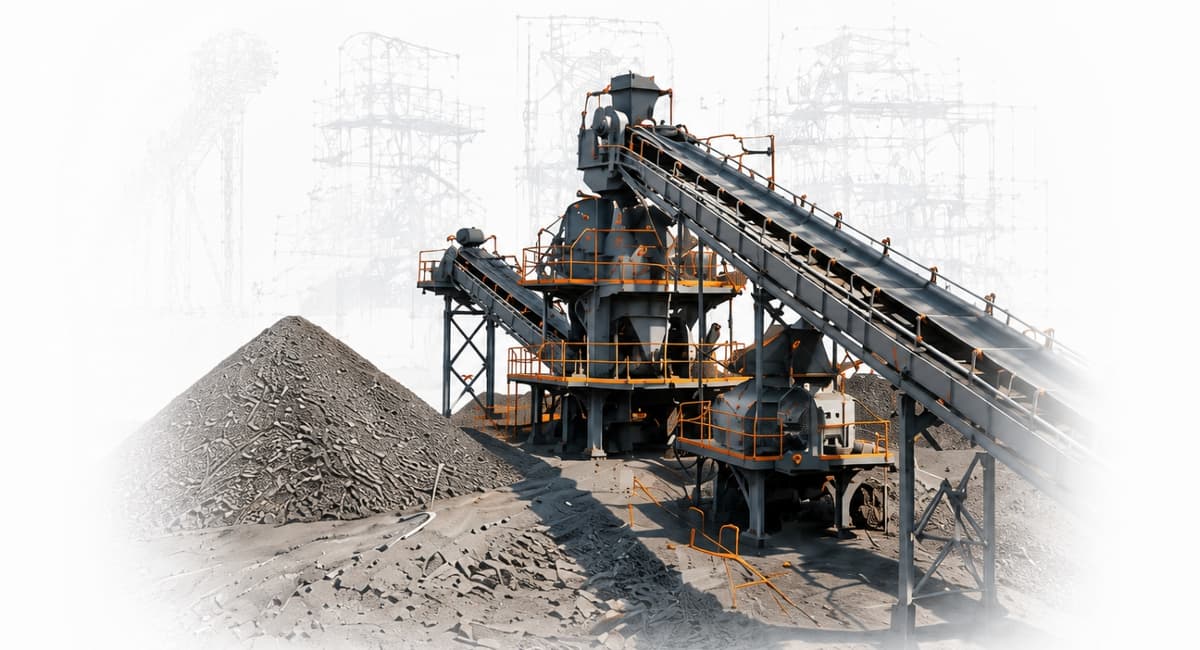
A jaw crusher is a heavy-duty machine used to break large rocks and stones into smaller pieces. It works by pressing the rock between two plates one stays still, while the other moves back and forth to crush the material.
A jaw crusher is often the first machine used in a quarry or mining site because it handles large rocks before they go to other crushing machines. This is why it is also known as a primary crusher.
If you have ever seen a large machine with a V-shaped crushing chamber that squeezes and breaks big rocks into smaller pieces, you have seen a jaw crusher in action.
In this guide, we will explain what a jaw crusher is, how it works, the different types of jaw crushers and the main parts of the machine. We will also explain common terms such as the pitman, toggle plate, jaw plate and flywheel in Easy language, so you can easily understand how the machine works.
What Is a Jaw Crusher?
A jaw crusher is a powerful machine used to break large rocks, ore and construction waste into smaller pieces. It works by squeezing material between two jaw plates one fixed and one moving.
The material enters from the top and is crushed as the moving jaw pushes against the fixed jaw. Once the pieces are small enough, they pass through the opening at the bottom.
Jaw crushers are commonly used as primary crushers, making them the first step in many quarrying, mining, and crushing operations.
Jaw Crusher Diagram
Understanding the main parts of a jaw crusher makes it easier to see how the machine works. Here are the key components:
- Fixed Jaw: The stationary plate that forms one side of the crushing chamber.
- Swing Jaw:The moving plate that crushes the material by moving toward the fixed jaw.
- Eccentric Shaft:The rotating shaft that creates the movement needed for crushing.
- Pitman:A heavy part that transfers movement from the eccentric shaft to the swing jaw.
- Toggle Plate:Connects the pitman to the swing jaw and helps transfer the crushing force.
- Flywheel:Stores energy and helps the crusher run smoothly during the crushing cycle.
- Toggle Seat:Supports the toggle plate and helps transfer its force to the swing jaw.
- Gape:The opening at the top where large rocks enter the crusher.
- CSS (Closed Side Setting):The smallest gap between the two jaws at the bottom. It helps control the size of the crushed material.
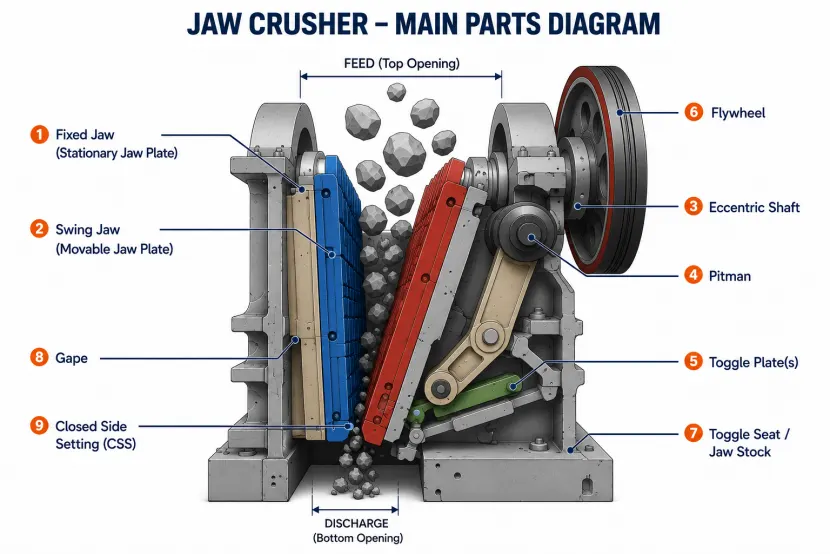
In a typical jaw crusher diagram, material enters from the top, moves through the V-shaped crushing chamber and exits from the bottom once it is small enough.
How Does a Jaw Crusher Work? (Working Principle)
Jaw crusher works by squeezing large rocks between two jaw plates. The moving jaw repeatedly moves toward and away from the fixed jaw, crushing the material into smaller pieces.
Here’s how the process works:
- Material enters from the topof the V-shaped crushing chamber.
- The eccentric shaft rotates, powered by a motor and flywheel.
- The pitman moveswith the eccentric shaft and transfers this movement to the toggle plate.
- The toggle plate moves the swing jaw, pushing it toward the fixed jaw to crush the material.
- The swing jaw moves back, allowing the crushed material to move further down the chamber.
- The process repeatsuntil the material is small enough to pass through the bottom opening.
Nip Angle and Reduction Ratio
Two important factors affect how well a jaw crusher works:
- Nip angle:The angle between the two jaw plates. It helps the jaws grip the material and pull it into the crushing chamber. If the angle is too wide, the material may slip instead of being crushed properly.
- Reduction ratio:This compares the size of the material entering the crusher with the size of the material coming out. For example, a 24-inch rock could be reduced to around 4–6 inches, depending on the machine and its settings.
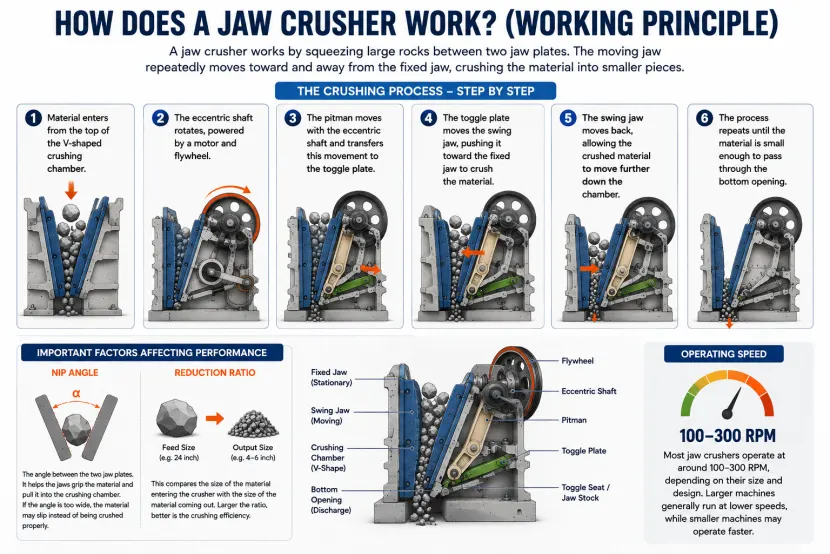
Most jaw crushers operate at around 100–300 RPM, depending on their size and design. Larger machines generally run at lower speeds, while smaller machines may operate faster.
Types of Jaw Crushers
Jaw crushers can be grouped in different ways, but the classic classification is based on where the swing jaw is pivoted. The three main types are:
- Blake Jaw Crusher:The swing jaw is pivoted at the top and moves more at the bottom. This design is widely used because it can handle a steady flow of material and works well for large-scale crushing.
- Dodge Jaw Crusher:The swing jaw is pivoted at the bottom, so it moves more at the top. It can produce a more consistent product size but may get blocked more easily. These crushers are now mostly used for laboratory and smaller-scale applications.
- Universal Jaw Crusher:The swing jaw is pivoted somewhere in the middle. This allows movement at both the top and bottom of the crushing chamber, giving it characteristics of both Blake and Dodge designs.
Today, Blake-type jaw crushers are much more common in mining and quarrying, while Dodge and Universal designs are mainly used in specific applications.
Where Are Jaw Crushers Used?
Jaw crushers are used in many industries where large and hard materials need to be broken into smaller pieces. Common applications include:
- Mining and quarrying:Crushing hard rock, ore, granite, and basalt as the first step.
- Construction and demolition:Breaking concrete, bricks and asphalt for recycling and reuse.
- Aggregate production:Producing crushed stone for roads, concrete, and asphalt.
- Cement and other industries:Reducing raw materials before they go through further processing.
In simple terms, jaw crushers are mainly used when large, tough materials need to be reduced to a manageable size before the next stage.
Jaw Crusher vs. Other Crushers
Jaw crushers are usually used for the first stage of crushing, while other crushers are used to make the material smaller or more uniform.
- Jaw Crusher vs. Cone Crusher:A jaw crusher handles large material during primary crushing. A cone crusher is usually used later to produce smaller and more uniform pieces.
- Jaw Crusher vs. Impact Crusher:A jaw crusher crushes material by squeezing it between two jaws, making it suitable for hard and abrasive rock. An impact crusher uses high-speed impact and is often used when a better-shaped final product or more fine material is needed.
In many crushing plants, the jaw crusher does the initial heavy crushing, while cone or impact crushers handle the later stages.
The Bottom Line
A jaw crusher is a simple but powerful machine that uses a moving jaw to squeeze and break large rocks into smaller pieces. The main parts, such as the fixed jaw, swing jaw, toggle plate and eccentric shaft, all work together to make this happen.
Understanding the different jaw crusher types and how they work can help you choose the right machine for your needs. The best choice depends on factors such as the type of material you are crushing, the size of the feed and the size of the final product.
If you are planning to buy or use a jaw crusher, it is always a good idea to discuss your requirements with a crushing equipment specialist to find the right machine for your application.