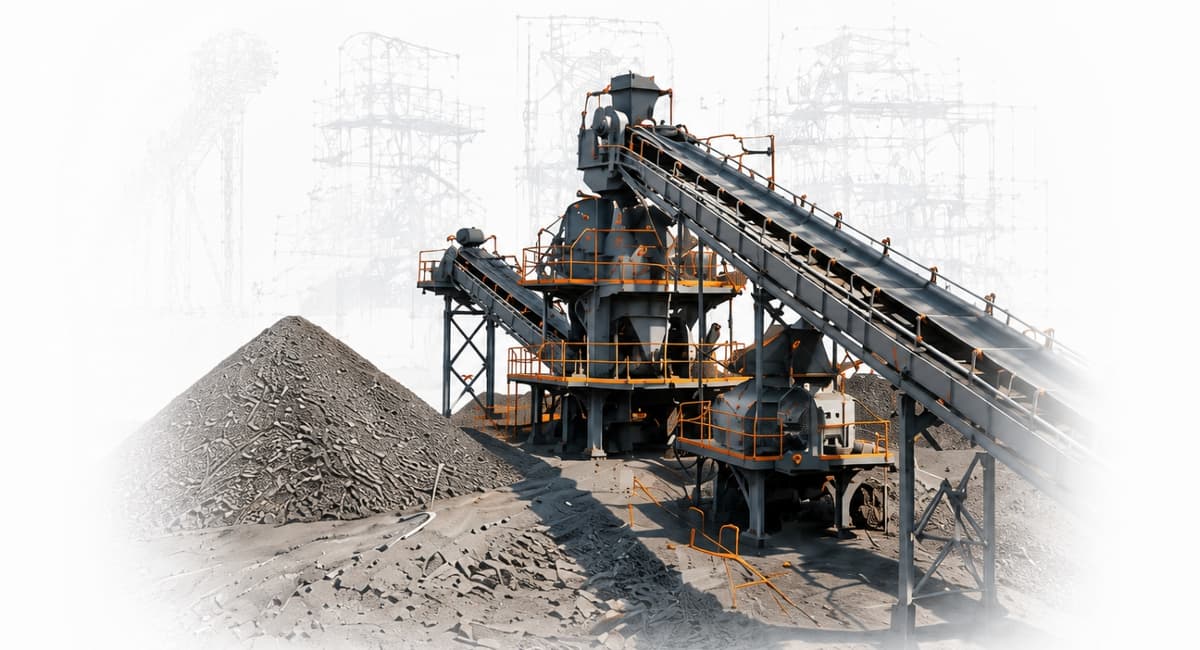
When large rocks and minerals need to be reduced into smaller, usable sizes, the right crushing equipment makes a major difference. A cone crusher is one of the most important machines used for this purpose, particularly when hard and abrasive materials need to be processed efficiently after primary crushing.
Unlike a jaw crusher, which is commonly used for primary size reduction, a cone crusher is mainly used in secondary and tertiary crushing stages. It uses compression to break material between a moving mantle and a stationary concave, producing a controlled and relatively uniform output.
Cone crushers are widely used in mining, quarrying, aggregate production, road construction and mineral processing. Their ability to handle hard materials while maintaining consistent crushing performance makes them an important part of modern crushing plants.
In this guide, we will explain what a cone crusher is, how a cone crusher works, the different types of cone crushers, their applications, advantages and how to select the right cone crusher machine for your operation.
What Is a Cone Crusher?
A cone crusher is a compression-type crushing machine designed to reduce rocks, minerals and other hard materials into smaller particles.
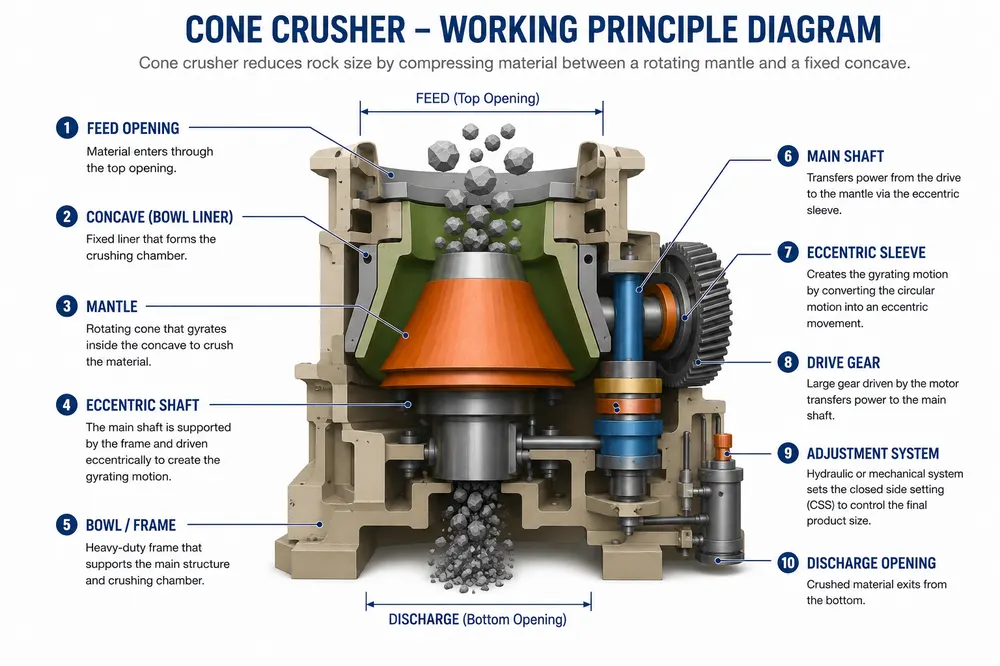
The machine consists primarily of a rotating or gyrating crushing head fitted with a mantle and a stationary concave, also known as a bowl liner. Material enters the crushing chamber from the top. As the mantle moves eccentrically toward and away from the concave, the material is repeatedly compressed.
This compression breaks the material into smaller pieces. Once the particles are small enough to pass through the discharge opening, they leave the crushing chamber and continue to the next stage of processing.
A cone crusher machine is particularly suitable for hard and abrasive materials such as granite, basalt, iron ore and other mineral-based materials. Depending on its design and configuration, it can be used for secondary, tertiary and in some applications, quaternary crushing.
The machine's performance depends on several factors, including feed characteristics, crusher settings, chamber design, feed distribution and operating conditions.
How Does a Cone Crusher Work?
The cone crusher working principle is based on continuous compression between the mantle and concave.
The crushing process can be understood through the following stages.
1. Material Feeding
Raw material enters the top of the crusher through a controlled feeding system. Consistent feed distribution is important because uneven feeding can reduce crushing efficiency and increase wear on the crushing components.
2. Material Enters the Crushing Chamber
The material moves into the space between the mantle and concave. This area is known as the crushing chamber.
The shape and profile of the chamber influence how material moves through the crusher and affect the size and characteristics of the finished product.
3. Compression Crushing
The mantle moves in an eccentric, gyrating motion. When the mantle moves closer to the concave, the material between the two surfaces is compressed and fractured.
As the mantle moves away, space opens within the chamber, allowing the crushed material to move downward.
This cycle occurs continuously as long as material is being fed into the machine.
4. Controlled Discharge
Material continues moving downward through the crushing chamber. Particles that are still too large remain in the crushing zone for further reduction.
The final product exits when it is small enough to pass through the crusher's discharge opening.
One important operating parameter is the Closed Side Setting (CSS), which refers to the smallest distance between the mantle and concave during the crushing cycle. Adjusting the CSS can influence the product size, capacity and crushing performance.
The Open Side Setting (OSS) represents the larger opening between the crushing surfaces. Together, these settings help define the operating characteristics of the crusher.
Main Parts of a Cone Crusher
Understanding the main components makes it easier to understand how a cone crusher operates.
Mantle
The mantle is the moving crushing surface. It is mounted around the crushing head and moves eccentrically during operation to compress material against the concave.
Concave or Bowl Liner
The concave is the stationary wear surface surrounding the mantle. It forms the other side of the crushing chamber and works with the mantle to reduce material.
Both the mantle and concave are wear components and require inspection and replacement as they gradually wear during operation.
Main Shaft
The main shaft supports key crushing components and transfers the required movement and forces during the crushing process.
Eccentric Mechanism
The eccentric mechanism creates the gyrating movement of the crushing head. Eccentric throw, which refers to the amount of movement generated by the eccentric mechanism, is an important operating characteristic that can influence crushing performance.
Drive System
The drive system provides the mechanical power required to operate the crushing mechanism continuously.
Hydraulic System
Modern hydraulic cone crushers can use hydraulic systems for functions such as crusher setting adjustment, overload protection and maintenance-related operations.
Types of Cone Crushers
There is no single cone crusher design suitable for every application. Different configurations have been developed to meet different feed sizes, crushing stages, capacity requirements and product specifications.
1. Standard Cone Crusher
Standard cone crushers are generally associated with secondary crushing applications where relatively large feed material needs to be reduced before further processing.
They are suitable for operations where the primary objective is efficient reduction rather than producing the finest possible product.
2. Short Head Cone Crusher
A short head cone crusher is designed with a finer crushing chamber and is commonly used for tertiary crushing.
It is suitable when a smaller and more controlled product is required after the secondary crushing stage.
3. Single-Cylinder Hydraulic Cone Crusher
A single-cylinder hydraulic design uses hydraulic technology to assist with crusher adjustment and protection.
Depending on the configuration, it can provide convenient setting control and protection when uncrushable material enters the crushing chamber.
4. Multi-Cylinder Hydraulic Cone Crusher
Multi-cylinder hydraulic cone crushers use several hydraulic cylinders around the crusher structure. These machines are generally designed for demanding applications requiring high capacity, controlled adjustment and robust crushing performance.
They can be used in large-scale mining, quarrying and aggregate operations.
5. Spring Cone Crusher
Spring cone crushers use a spring-based overload protection mechanism. When uncrushable material enters the chamber, the system can allow the crusher to release pressure and return to its normal operating position.
Although hydraulic technology is widely used in modern equipment, spring cone crushers remain relevant in certain crushing applications.
Choosing Between Different Types
The right type of cone crusher depends on more than the desired output size. Feed size, material hardness, abrasiveness, production capacity, crushing stage and required product gradation should all be considered.
For example, a machine selected for secondary crushing may require a different chamber configuration from one used for fine tertiary crushing.
Cone Crusher Applications
The versatility of a cone crusher machine makes it suitable for many industries.
Mining
Cone crushers are commonly used in mining to reduce hard rock and mineral-bearing materials after primary crushing. They can process materials such as iron ore, copper ore and other hard mineral deposits.
In larger mining operations, cone crushers may form part of a multi-stage crushing and screening circuit.
Quarrying
Quarries use cone crushers to process hard rock into aggregates of different sizes.
A typical quarry setup may combine a primary jaw crusher with a cone crusher, a vibrating screen and a conveyor system to achieve the required product sizes.
Aggregate Production
Aggregate producers use cone crushers to manufacture materials for concrete, asphalt and infrastructure projects.
The crusher can help produce controlled aggregate sizes while handling materials that may be too hard or abrasive for less suitable crushing equipment.
Road Construction
Crushed stone and aggregates are essential for road bases, asphalt and other infrastructure applications. Cone crushers can reduce quarried rock into suitable sizes for these construction requirements.
Mineral Processing
Cone crushers can also be used ahead of screening, grinding or separation processes where further reduction of mineral material is required.
Benefits of Using a Cone Crusher
A properly selected cone crusher can provide several operational advantages.
Efficient compression crushing: The crushing mechanism is well suited to many hard and abrasive materials.
Controlled product size: Crusher settings and chamber configuration can be adjusted to meet the required output.
Suitable for multiple crushing stages: Cone crushers can perform effectively in secondary and tertiary crushing circuits.
Continuous operation: The gyrating crushing action allows material to be processed continuously when the crusher is correctly fed.
Integration with complete plants: Cone crushers can work alongside feeders, screens, conveyors and primary crushers to form a complete crushing circuit.
Adaptability: Different machine sizes, chamber configurations and operating settings allow the equipment to be matched to different applications.
How to Choose the Right Cone Crusher Machine
Selecting the right cone crusher machine requires an understanding of both the material and the complete crushing circuit.
Start by evaluating the maximum feed size and the typical size distribution of the material. The crusher must be capable of accepting the intended feed without creating unnecessary operating problems.
Material characteristics are equally important. Hardness, abrasiveness, moisture and material shape can influence crusher selection and wear rates.
Next, consider the required capacity and final product size. The crusher should be capable of meeting the required tonnes-per-hour target while maintaining the desired product characteristics.
The intended crushing stage also matters. A secondary crushing application may require a different chamber and operating configuration from a tertiary application.
Finally, consider maintenance access, wear-part availability, energy requirements, hydraulic features and after-sales support. A machine that performs well on paper but is difficult to maintain may not provide the best long-term value.
Cone Crusher Price: What Should Buyers Consider?
When comparing cone crusher price or cone crusher machine price, it is important to look beyond the initial purchase cost.
The final price can vary according to crusher capacity, machine size, technology, hydraulic systems, chamber configuration, automation and construction quality.
A complete cone crusher plant will cost more than an individual crusher because it may include feeders, screens, conveyors, electrical systems and other supporting equipment.
Operating costs should also be considered. Wear-part consumption, maintenance requirements, energy use and downtime can significantly affect the total cost of ownership.
For this reason, the most economical cone crusher is not necessarily the machine with the lowest initial price. The better choice is generally the machine that provides the required production performance with manageable operating and maintenance costs.
Why Choose Pithal Machine for Crushing Solutions?
For businesses looking for crushing equipment, selecting the machine is only one part of the decision. Equipment reliability, application suitability, technical support and long-term serviceability also matter.
Pithal Machine develops crushing solutions for applications across industries that require dependable material reduction.
Its Prime Cone Crusher is designed for crushing applications where controlled reduction and reliable performance are important. Depending on the project requirements, it can be considered as part of a broader crushing setup alongside Pithal Machine's other equipment.
For primary crushing requirements, the Prime Jaw Crusher can be integrated into the crushing circuit, while the Prime Crusher Bucket provides an excavator-mounted option for on-site crushing applications.
Choosing equipment according to the complete material-processing requirement allows operators to build a more practical and efficient crushing solution instead of selecting individual machines in isolation.
Cone Crusher Maintenance Tips
Regular maintenance plays an important role in maintaining crusher performance and extending component life.
Operators should inspect the mantle and concave regularly for excessive wear and replace them according to the manufacturer's recommendations.
The lubrication system should also be monitored because inadequate lubrication can increase friction, heat and component wear.
Feed distribution should remain consistent and the crusher should not be routinely overloaded beyond its intended operating capacity.
Hydraulic systems, drive components, bearings and other critical parts should be inspected according to the recommended maintenance schedule.
Good maintenance practices can reduce unexpected downtime and help maintain stable crushing performance throughout the machine's operating life.
Conclusion
A cone crusher is a critical component in many modern crushing operations, particularly where hard and abrasive materials need to be reduced after primary crushing. Its compression-based working principle, adjustable settings and range of configurations make it suitable for secondary and tertiary crushing applications.
Understanding the cone crusher working principle, different types, applications and selection factors is essential when choosing equipment for a new or existing crushing plant.
For businesses evaluating crushing solutions, the decision should go beyond cone crusher price. Feed characteristics, production capacity, product requirements, maintenance, wear costs and the overall plant configuration all influence long-term performance.
With the right machine and a properly designed crushing circuit, equipment such as Pithal Machine's Prime Cone Crusher, supported by solutions such as the Prime Jaw Crusher and Prime Crusher Bucket, can form part of an efficient material-processing setup tailored to the requirements of the application.