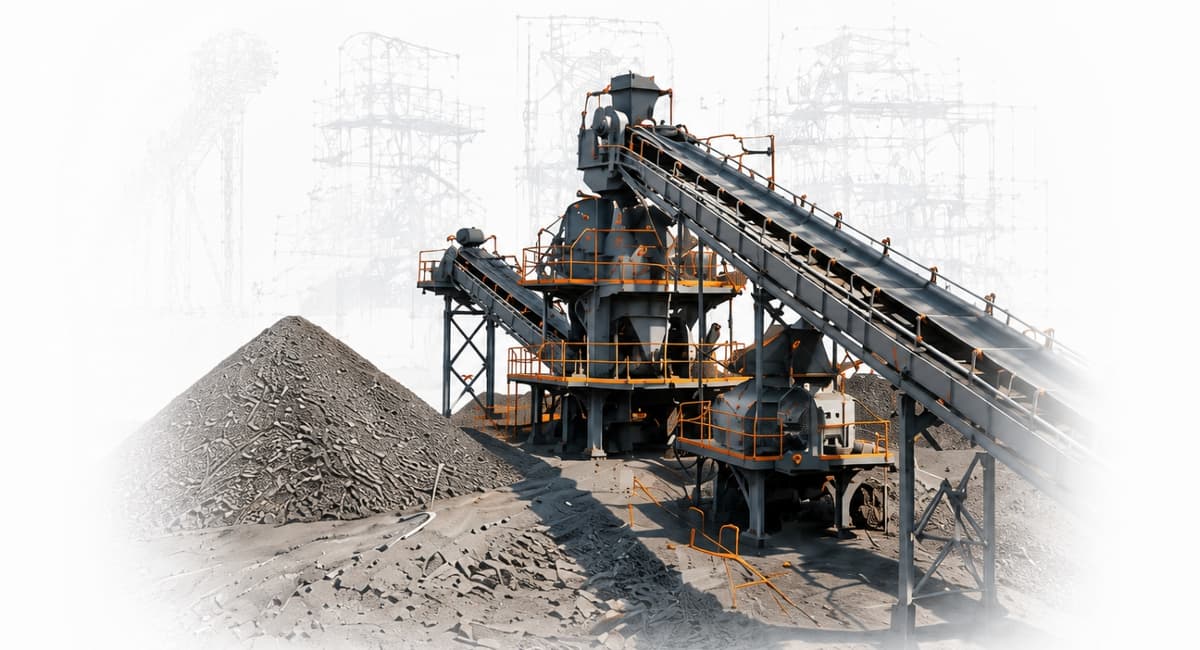
Primary, secondary and tertiary crushing are the main stages used to progressively reduce rock and other materials to the size and quality required for construction, mining and aggregate applications. Instead of trying to turn large quarry rocks into a finished product in a single step, a crushing plant usually divides the work between different stages.
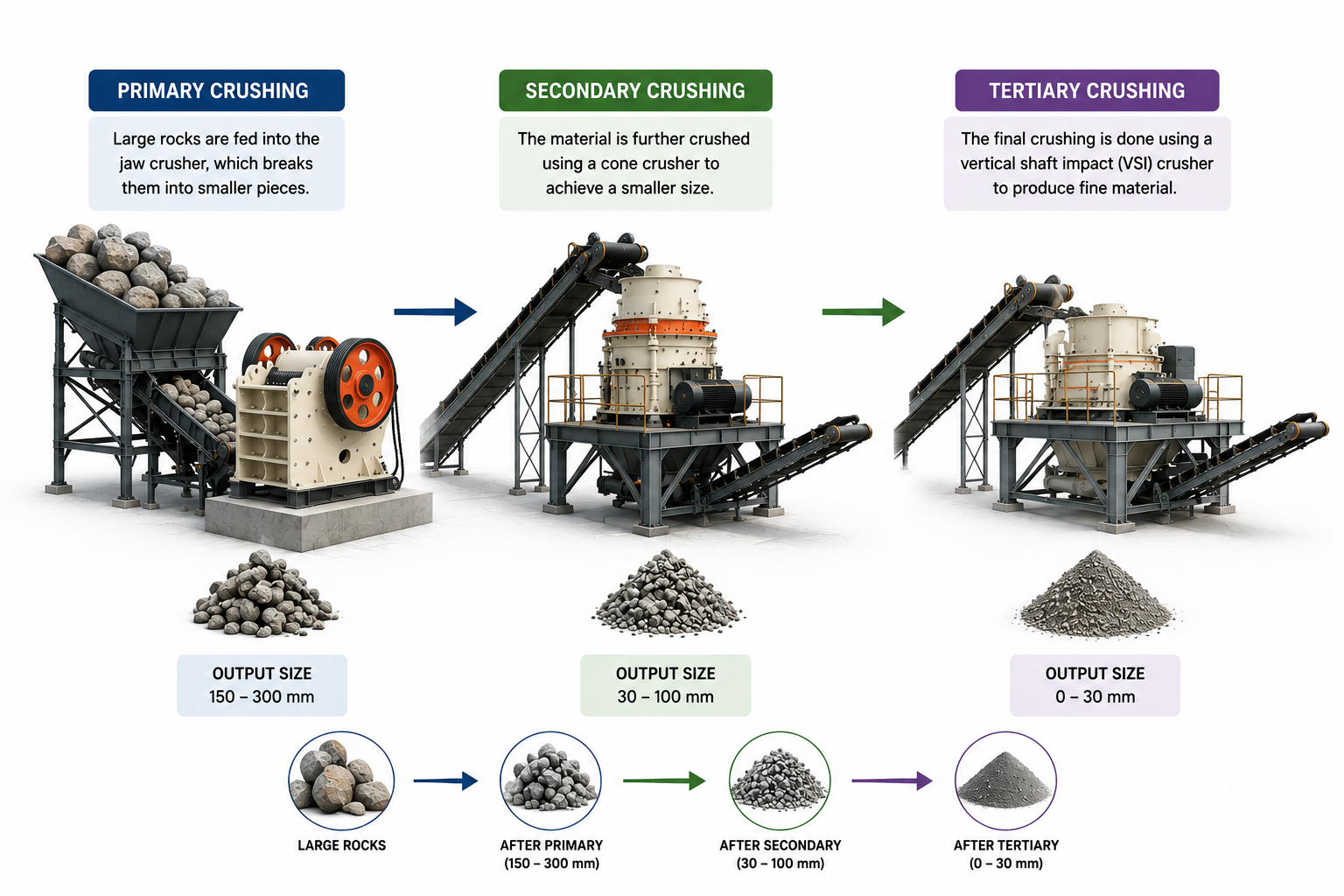
Primary crushing handles the largest feed material and performs the initial size reduction. Secondary crushing takes the primary crusher's output and reduces it further, while tertiary crushing is used when a finer product, tighter gradation or improved particle shape is required.
The number of stages required is not the same for every operation. It depends on the size and characteristics of the feed material, production capacity, required reduction and final product specifications.
It is also important to understand that primary, secondary and tertiary are crushing stages, not fixed categories of crusher machines. A jaw crusher is commonly used for primary crushing, while cone crushers are frequently used for secondary or tertiary duties. The actual role of a crusher depends on how the complete crushing circuit is designed.
What Are Primary, Secondary and Tertiary Crushing?
The easiest way to understand the three crushing stages is to look at them as a progressive size-reduction process.
Primary crushing is the first stage. Large rocks from a quarry, mine or excavation site enter the primary crusher and are reduced to a manageable size.
Secondary crushing follows primary crushing. The material is already smaller, so the secondary crusher can concentrate on producing a more controlled intermediate product.
Tertiary crushing provides another level of reduction when the application requires finer material, a specific gradation or better particle shape.
A typical three-stage crushing process may look like this:
Raw Material → Primary Crusher → Screening → Secondary Crusher → Screening → Tertiary Crusher → Final Screening → Finished Product
This does not mean every plant needs three crushers. Some operations can achieve their target product with one or two stages, while others require a three-stage circuit or additional processing.
What Is Primary Crushing?
Primary crushing is the first stage of size reduction in a conventional crushing plant. It receives the largest and least-processed material and prepares it for the rest of the operation.
The feed can consist of large, irregular rocks with significant differences in size. Primary crushing equipment therefore needs to withstand heavy loads and handle the expected feed size without becoming a bottleneck for the rest of the plant.
A jaw crusher is one of the most widely used machines for primary crushing. It works by compressing material between a fixed jaw and a moving jaw. As the moving jaw approaches the fixed jaw, the rock is broken into smaller pieces. The material eventually exits through the discharge opening.
How Primary Crushing Works
Material is normally delivered to the primary crusher through a feeder. The feeder controls the flow of material and helps maintain a consistent supply to the crushing chamber.
Once inside the crusher, mechanical force breaks the large rocks into smaller fragments. The size of the resulting material is influenced by the crusher design, feed size, operating settings and characteristics of the rock.
The output from primary crushing is generally not the final product. Instead, it becomes the feed for screening and further crushing.
For example, a quarry may extract very large pieces of hard rock that cannot be used directly as aggregate. Primary crushing reduces those pieces to a size that can be transported through the plant and processed by secondary equipment.
Common Primary Crushers
Jaw crushers are commonly selected when large feed sizes and hard materials need to be handled. Gyratory crushers are also used in high-capacity mining operations, while some impact crushers can perform primary duties when the material is suitable.
The important point is that primary crushing describes the machine's position and function within the process rather than the specific type of crusher being used.
What Is Secondary Crushing?
Secondary crushing is the stage that follows primary crushing. By this point, the largest rocks have already been reduced, allowing the next crusher to focus on producing a smaller and more consistent material.
Secondary crushing is often necessary when the primary crusher cannot achieve the desired product size efficiently in one step.
Cone crushers are widely used for secondary crushing, especially in applications involving hard and abrasive rock. Depending on the material and required product, impact crushers can also be used.
How Secondary Crushing Works
Material from the primary crusher enters the secondary crusher at a reduced size. The machine applies compression, impact or another form of mechanical force to reduce the particles further.
In a cone crusher, material is compressed between the mantle and concave as it moves through the crushing chamber. The crusher setting influences the size of the discharged material, while feed characteristics, chamber design, operating conditions and material flow also affect the final result.
The output from secondary crushing may already meet the requirements for certain coarse aggregate applications. If a finer product is required, the material can move into tertiary crushing.
What Is Tertiary Crushing?
Tertiary crushing is the third stage of crushing and is used when additional reduction or more controlled product characteristics are required.
At this point, the material has already passed through primary and secondary crushing. The feed entering the tertiary crusher is therefore much smaller than the original quarry or mine feed.
Tertiary crushing can be used to produce finer aggregate, achieve tighter product specifications or improve particle shape. Cone crushers and vertical shaft impactors, commonly known as VSI crushers are often considered for these applications.
How Tertiary Crushing Works
The tertiary crusher receives material that has already been reduced by earlier stages. It applies additional crushing force to bring the material closer to its required final size.
The role of tertiary crushing can vary from plant to plant. In some operations, it is mainly about producing a finer size. In others, the focus may also be on particle shape and the production of manufactured sand.
VSI crushers are particularly relevant where particle shape is important because their high-speed impact action can help produce more cubical particles and fine material.
The final product still depends on factors such as crusher configuration, feed characteristics, operating settings and screening.
Primary vs Secondary vs Tertiary Crushing
Although all three stages reduce material size, their roles within the crushing circuit are different.
The table is a general guide rather than a fixed rule. Crusher selection should always be based on the material, feed size, required capacity, reduction requirement and final product.
Are Crusher Types the Same as Crushing Stages?
No. This is one of the most important distinctions to understand.
Primary, secondary and tertiary describe the stage at which crushing takes place. Jaw, cone, impact and VSI describe different types of crushing equipment.
A jaw crusher is commonly used in primary applications because its design is well suited to large feed material. A cone crusher is frequently used for secondary or tertiary crushing because it can provide controlled reduction after the material has already been processed.
However, a crusher is not permanently classified as “primary,” “secondary” or “tertiary.” Its role depends on where it is installed in the circuit and what it is expected to accomplish.
This is why selecting a crusher should involve more than simply asking which machine is used for a particular stage. Feed size, material hardness, abrasiveness, capacity, reduction ratio and final product requirements all need to be considered.
The Role of Screening Between Crushing Stages
Crushing and screening work together in most modern crushing plants. A crusher reduces the material, while a screen separates it according to size.
Consider a simple circuit where material leaves the primary crusher and enters a vibrating screen. Material that is already small enough can move forward, while oversized material is directed to the secondary crusher.
The same principle can be applied after secondary crushing.
This prevents material that has already reached the required size from being unnecessarily crushed again. It also helps control the gradation of the final product.
A simplified circuit can therefore look like this:
Primary Jaw Crusher → Vibrating Screen → Secondary Cone Crusher → Vibrating Screen → Tertiary Crusher → Final Screen
The actual arrangement will vary depending on the plant's production requirements.
What Is Closed-Circuit Crushing?
In a closed-circuit crushing system, material that is still too large after crushing is returned to the crusher for another pass.
For example, after secondary crushing, a vibrating screen separates the material into different sizes. The correctly sized material can leave the circuit, while oversized particles are sent back to the crusher.
The process continues until the particles meet the required size.
This arrangement provides greater control over product sizing and can be particularly useful when consistent aggregate gradation is important.
In an open circuit, by comparison, material may leave the crushing stage without being automatically recirculated through the crusher based on a screening loop.
Why Use Multiple Crushing Stages?
The main reason for using multiple crushing stages is to divide a large overall size reduction into manageable steps.
Imagine a quarry starting with very large rocks but requiring a much smaller aggregate product. Trying to perform the entire reduction in one operation can place unnecessary demands on a single crusher and make product control more difficult.
Multiple stages allow each crusher to perform a specific part of the reduction.
This is closely related to the reduction ratio, which describes the relationship between the feed size and the product size. If material enters a crusher at around 300 mm and the desired product is around 100 mm, the required reduction is approximately 3:1.
In a multi-stage crushing plant, the overall reduction can be distributed between different crushers instead of expecting one machine to perform the entire reduction.
This can help the plant handle material more effectively while giving operators greater control over the final product.
Can One Crusher Do All Three Crushing Stages?
A single crusher may perform different duties depending on its design and operating conditions but that does not mean one machine is automatically suitable for all three stages.
The major limitation is the relationship between feed size, reduction requirement, capacity and final product size.
A crusher designed and configured to accept large feed material may not be the most suitable choice for producing a very fine final product. Similarly, equipment designed for fine crushing may not be capable of accepting the original large quarry feed.
For this reason, multi-stage crushing is commonly used when a substantial reduction is required. Each machine can be selected according to the size and characteristics of the material entering that stage.
How a Three-Stage Crushing Plant Works
A typical three-stage crushing plant starts with raw material being delivered to a feeder. The feeder supplies the material to the primary crusher, which performs the initial reduction.
The primary crusher output then passes through a screen. Material that meets the required size can move forward, while larger particles are directed to the secondary crusher.
After secondary crushing, another screening stage separates the material. Depending on the product requirements, correctly sized aggregate can be removed from the circuit while material requiring additional reduction moves to the tertiary crusher.
The tertiary crusher performs the final stage of reduction or shaping. A final screening stage then separates the finished products according to the required sizes.
Oversized material can be recirculated where the plant is designed for closed-circuit operation.
This coordinated arrangement allows crushers, screens, feeders and conveyors to work as one system rather than as isolated machines.
How to Choose the Right Crushing Stages
The right crushing configuration starts with the material and the final product, not with a particular crusher model.
Feed size determines how large the initial crushing equipment needs to be. A plant receiving large quarry rock requires different equipment from one processing already-sized material.
Material hardness and abrasiveness influence crusher selection and wear. Hard rocks such as granite and basalt can place significant demands on crushing equipment.
Feed gradation and moisture also matter. Variations in feed size can affect crusher loading, while excessive moisture can influence material flow and screening performance.
The required final size and particle shape are equally important. Coarse aggregate may require fewer stages, whereas fine aggregate or manufactured sand may require additional crushing and shaping.
Finally, production capacity needs to be considered across the entire circuit. The crusher, screen, feeder and conveyor capacities should be compatible so that one part of the plant does not unnecessarily restrict the rest.
Pithal Machine Crushing Solutions
Different crushing applications require different equipment configurations. The right choice depends on the feed material, required reduction, production capacity and final product.
Pithal Machine offers crushing solutions for different material-processing requirements, including the Prime Jaw Crusher, Prime Cone Crusher and Prime Crusher Bucket.
The Prime Jaw Crusher is suited to applications where large feed material needs robust primary size reduction before further processing.
The Prime Cone Crusher is relevant to applications requiring controlled reduction of already-processed material and can be considered for secondary or tertiary duties depending on the crushing circuit and product requirements.
For projects where crushing needs to take place directly at the worksite, the Prime Crusher Bucket provides an excavator-mounted crushing solution. Instead of transporting every piece of material to a fixed crushing plant, suitable material can be processed on site, depending on the application and equipment compatibility.
Pithal Machine also provides Vibrating Screens for material separation, an important part of a crushing circuit where controlled sizing and product gradation are required.
The objective is not simply to choose a crusher. It is to develop an equipment combination that works efficiently as a complete material-processing system.
Final Thoughts
Primary, secondary and tertiary crushing represent different stages of a progressive size-reduction process. Primary crushing handles large feed material, secondary crushing performs further reduction and tertiary crushing provides finer sizing or additional particle shaping when required.
The stages should not be confused with specific crusher types. A jaw crusher, cone crusher, impact crusher or VSI crusher can have different roles depending on the design and requirements of the complete crushing circuit.
Screening is equally important because it separates correctly sized material and allows oversized particles to return for further crushing where required. When crushers, screens, feeders and conveyors are properly matched, the entire plant can operate as a coordinated material-processing system.
For businesses planning a new crushing plant or upgrading an existing operation, the right approach is to start with the material, feed size, production target and final product requirements. From there, the appropriate crushing stages and equipment can be selected.
Pithal Machine's range of Prime Jaw Crusher, Prime Cone Crusher, Prime Crusher Bucket and Vibrating Screens provides options for different crushing and material-processing requirements from primary size reduction to further crushing and on-site material processing.