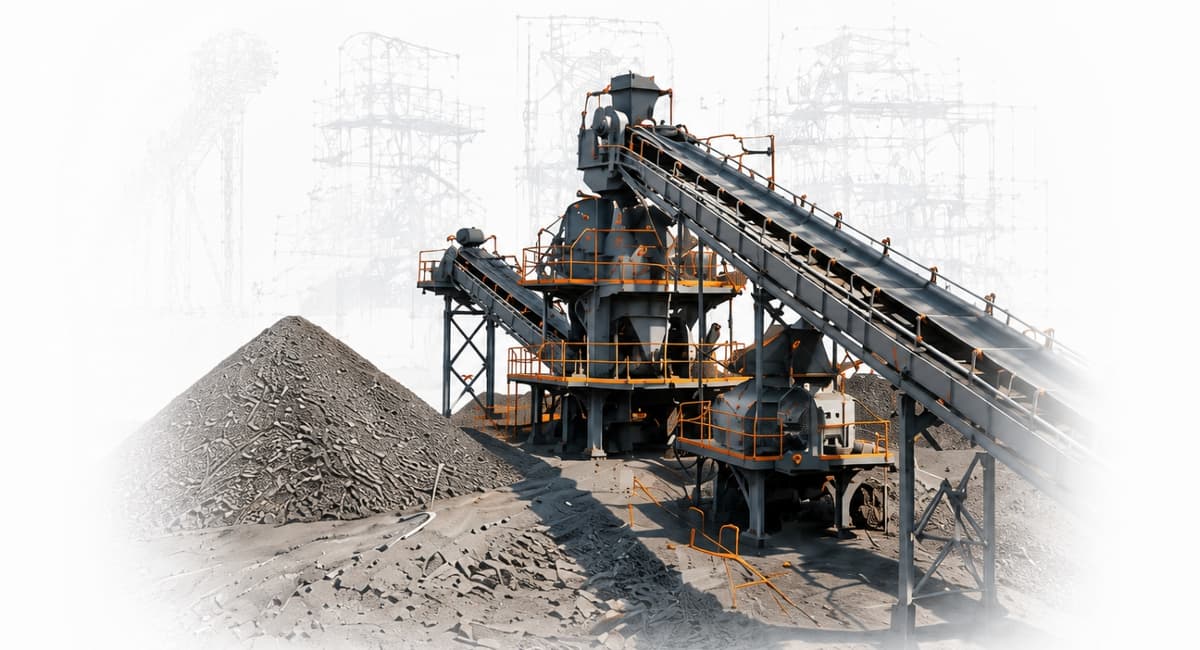
Choosing the right primary crusher is an important decision when designing a mining, quarrying or aggregate crushing plant. The primary crusher receives large pieces of rock or run-of-mine material and reduces them to a size that can be handled by conveyors and downstream equipment.
Two widely used types of primary crushing equipment are jaw crushers and gyratory crushers. Both reduce material through compression but their construction, crushing action, capacity range, installation requirements and typical applications are different.
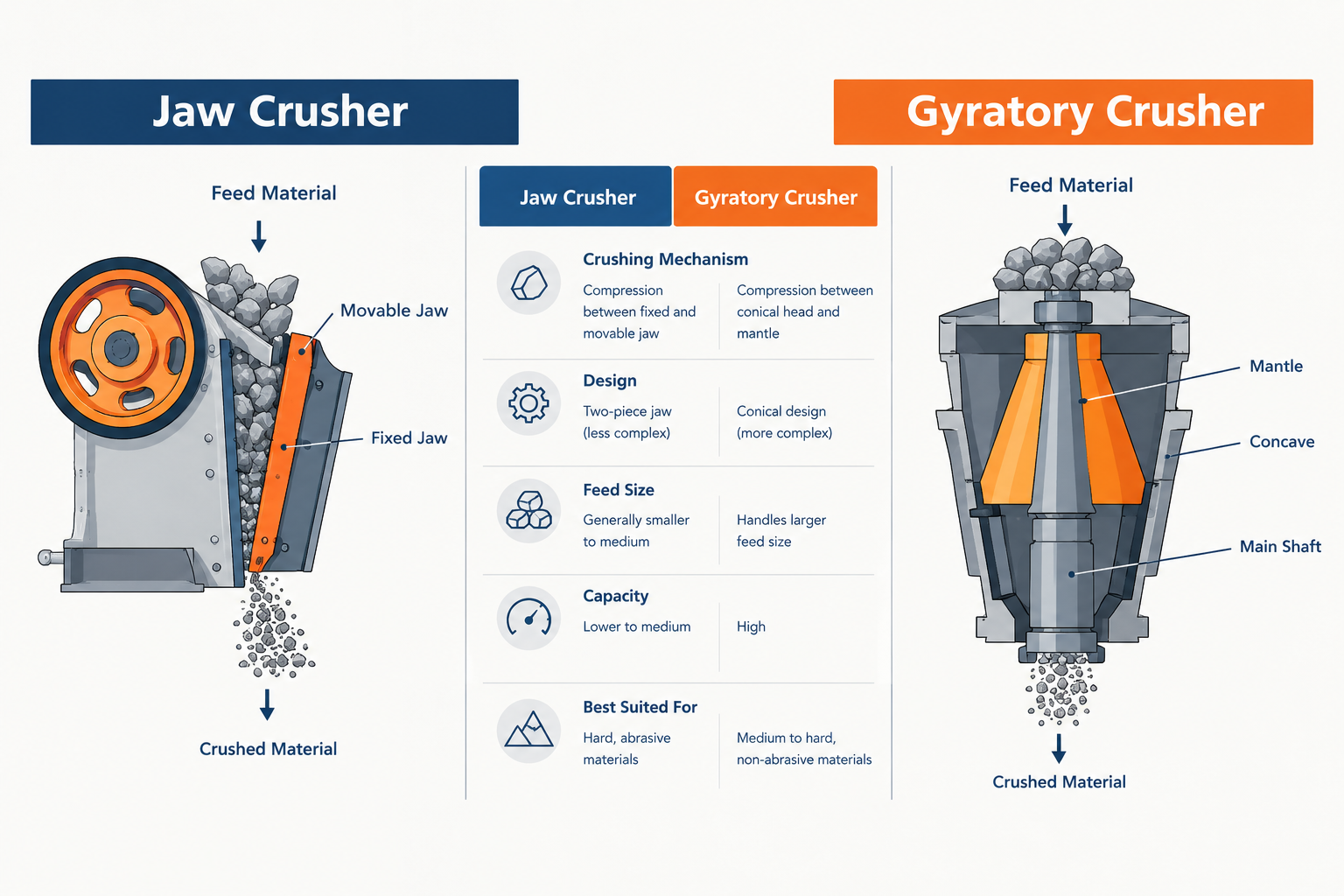
A jaw crusher uses a moving jaw working against a fixed jaw, while a gyratory crusher uses an eccentrically moving mantle inside a stationary concave. Understanding these differences helps plant designers and operators select equipment according to feed size, production requirements, material characteristics, plant layout and maintenance considerations.
What Is a Jaw Crusher?
A jaw crusher is a compression-type machine used for primary crushing in quarrying, mining, construction and aggregate processing. Its basic design consists of a fixed jaw and a moving jaw that form a V-shaped crushing chamber.
The moving jaw is connected to an eccentric mechanism. As it moves toward the fixed jaw, material inside the chamber is compressed and fractured. When the jaw moves away, the crushed material moves downward through the chamber.
Jaw crushers are available in different sizes and configurations, making them suitable for a wide range of crushing applications. Depending on the equipment design, they can be installed in stationary plants or incorporated into mobile and portable crushing systems.
Jaw Crusher Working Principle
The jaw crusher working principle is based on repeated compression.
Large feed material enters through the top of the crushing chamber. The eccentric shaft moves the jaw toward the fixed jaw, reducing the space between the two crushing surfaces. The material is compressed until it fractures.
When the moving jaw moves back, the broken material falls farther down the chamber. The process repeats as the material moves toward the discharge opening.
The crusher setting influences the size of material leaving the machine. This makes the jaw crusher an effective first stage for reducing large rocks before they move to secondary crushing, screening or conveying equipment.
What Is a Gyratory Crusher?
A gyratory crusher is a heavy-duty primary crushing machine designed for applications where large quantities of material must be processed. It is commonly associated with large mining and mineral-processing operations.
Instead of two jaws, a gyratory crusher consists of a conical mantle positioned inside a stationary concave. The mantle is supported by a main shaft and moves through an eccentric gyrating motion.
The geometry of the crushing chamber allows material to enter from the top and move downward while being compressed between the mantle and concave. Unlike the reciprocating movement of a jaw crusher, the gyrating movement provides crushing around the chamber.
Gyratory Crusher Working Principle
The gyratory crusher working principle also relies primarily on compression.
Large rocks enter the crusher through the top of the chamber. An eccentric mechanism causes the mantle to move toward and away from the concave as it gyrates around the central axis.
When the mantle approaches the concave, the available space becomes smaller and the material is compressed. The fractured material then moves downward through the chamber as the crushing cycle continues.
Because crushing occurs continuously around the chamber, gyratory crushers are well suited to high-volume primary crushing applications where consistent material flow is important.
Jaw Crusher vs Gyratory Crusher: Key Differences
The difference between a jaw crusher and a gyratory crusher becomes clearer when their crushing mechanisms, capacity requirements, installation needs and operating environments are compared.
1. Crushing Mechanism
A jaw crusher uses two crushing surfaces: one fixed jaw and one moving jaw. The moving jaw follows a reciprocating motion and compresses material against the fixed jaw.
A gyratory crusher uses a mantle that moves eccentrically inside a stationary concave. The crushing gap changes continuously as the mantle gyrates.
2. Capacity and Throughput
Capacity is an important factor when selecting primary crushing equipment.
Jaw crushers are manufactured across a broad range of sizes and capacities. They are commonly used in quarrying, aggregate production, construction and mining operations where the required production rate can be matched to the appropriate machine size.
Gyratory crushers are generally selected for very high-throughput primary crushing applications. Their continuous crushing action and chamber design make them suitable for large operations where substantial quantities of run-of-mine material must be processed.
3. Feed Size
Both machines are capable of handling large feed material but the correct crusher must always be selected according to its specified feed opening and operating limits.
Jaw crushers can handle large blasted rock and are commonly installed as the first stage in aggregate and quarrying circuits.
Gyratory crushers can also accommodate large run-of-mine feed and are frequently considered where large mining operations require a high-capacity primary crushing stage.
4. Installation and Plant Requirements
Jaw crushers generally offer greater flexibility in terms of installation. Depending on the model, they can be used in stationary, portable or mobile crushing configurations.
Large gyratory crushers are typically installed as substantial stationary units. Their size and operating requirements can result in greater foundation, structural and plant-layout considerations.
5. Maintenance and Wear Parts
Jaw crushers have a relatively straightforward mechanical arrangement. Jaw plates are the primary wear components, while bearings, lubrication systems, fasteners and other mechanical components also require regular inspection.
Gyratory crushers have a more complex structure that includes components such as the mantle, concaves, main shaft, eccentric assembly, bearings and lubrication system. Maintenance planning is therefore particularly important for large installations.
6. Typical Operating Environment
Jaw crushers are used across a broad range of industries, including aggregates, quarrying, construction, road projects and mining.
Gyratory crushers are more commonly associated with large-scale mining and mineral-processing operations that require high-volume primary crushing.
Jaw Crusher vs Gyratory Crusher
Advantages of Jaw Crushers
Jaw crushers are widely used because they provide a practical combination of strength, versatility and relatively simple mechanical design.
One of their key advantages is flexibility. They can be used for primary crushing across quarrying, aggregate, construction and mining applications. Different machine sizes allow operators to select equipment according to the required feed size and production level.
Jaw crushers can also be useful where mobility is important. Depending on the configuration, a jaw crusher can form part of a stationary plant or be incorporated into a mobile crushing setup.
Advantages of Gyratory Crushers
The main advantage of a gyratory crusher is its suitability for high-volume primary crushing.
Its continuous crushing action allows material to move through the crushing chamber while the mantle continues gyrating. This makes the design particularly suitable for large mining and mineral-processing operations.
Gyratory crushers can also handle substantial run-of-mine feed when correctly selected and integrated into the plant. However, their larger size and infrastructure requirements mean they are generally considered when the scale of the operation justifies the installation.
Jaw Crusher Applications
Jaw crushers are commonly used in:
Aggregate crushing plants
Quarrying and stone processing
Mining operations
Road and infrastructure projects
Construction material processing
Mobile crushing plants
Primary hard-rock crushing
In a typical circuit, the jaw crusher performs the initial size reduction before the material moves through conveyors to secondary crushers and screening equipment.
Gyratory Crusher Applications
Gyratory crushers are commonly used for:
Large-scale mining
Mineral processing
Run-of-mine ore crushing
Large industrial crushing plants
High-volume primary crushing applications
They are particularly relevant when the crushing plant must process large quantities of material continuously and the project has the infrastructure required for a large stationary crusher.
Which Crusher Should You Choose?
There is no single answer to whether a jaw crusher or gyratory crusher is better. The appropriate choice depends on the complete crushing circuit.
A jaw crusher may be suitable when the project requires a flexible primary crusher, a broad range of production options, mobile or portable capability or a relatively straightforward equipment arrangement.
A gyratory crusher may be considered when the operation requires very high-volume primary crushing, large run-of-mine feed handling, continuous operation and the infrastructure needed for a large stationary crushing station.
Before selecting equipment, consider the following factors:
Required production capacity
Maximum feed size
Material hardness and abrasiveness
Desired product size
Plant layout and available space
Foundation and infrastructure requirements
Maintenance capabilities
Capital and operating costs
Requirements of downstream crushing and screening equipment
The objective is not simply to select the largest or most powerful machine. The crusher should provide the required performance while fitting efficiently into the overall plant design.
Pithal Machines for Crushing and Screening Solutions
Selecting the right primary crusher is an important part of developing a reliable crushing plant. The equipment should be matched to the material, feed size, production target and downstream processing requirements.
Pithal Machines provides crushing and screening equipment for applications across mining, quarrying, construction and aggregate processing. Its equipment range includes jaw crushers, cone crushers, bucket crushers, VSI crushers, vibrating screens and crushing plant solutions.
For applications requiring dependable primary crushing, explore the Pithal Machines Prime Jaw Crusher and review its product specifications, features and applications.
Conclusion
The comparison between jaw crusher vs gyratory crusher is ultimately about matching the crushing machine to the requirements of the operation.
Jaw crushers offer flexibility and a relatively straightforward design, making them suitable for a wide range of aggregate, quarrying, construction and mining applications. Gyratory crushers are designed around continuous crushing and are particularly suited to high-volume primary crushing in large-scale operations.
The right choice depends on more than crusher type. Feed characteristics, production requirements, plant infrastructure, maintenance needs and the complete crushing circuit should all be evaluated before equipment selection.
A properly matched primary crusher can provide a reliable foundation for the rest of the crushing and screening process, helping the plant maintain consistent material flow from the first crushing stage onward.