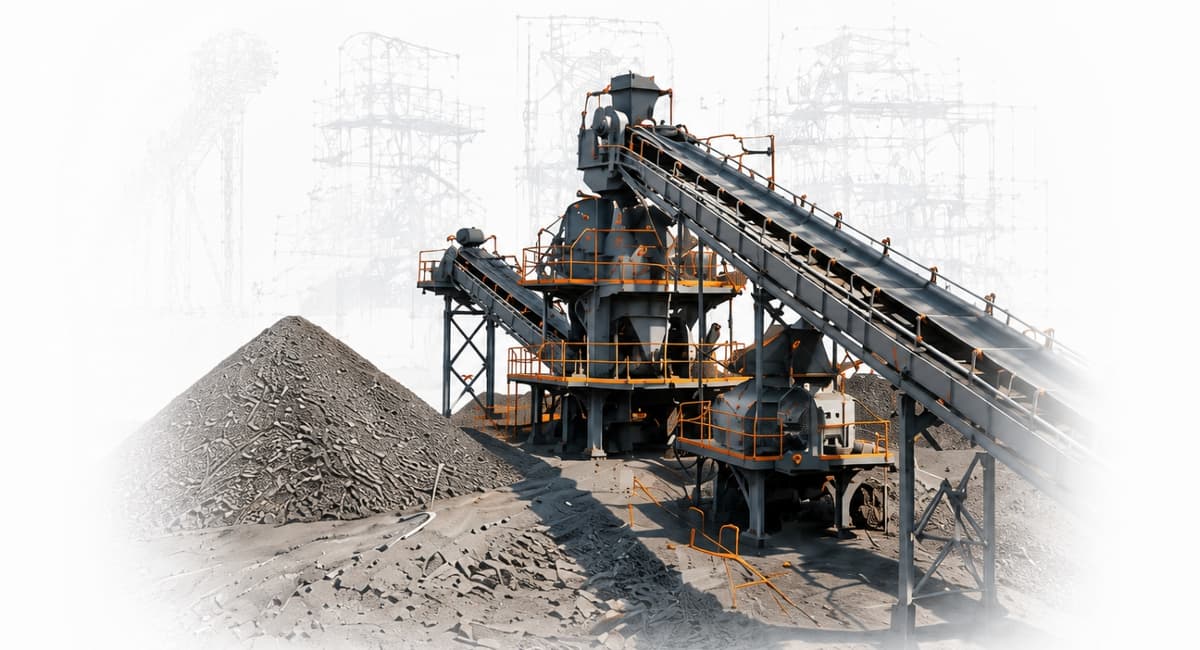
Choosing the right crusher is important for any mining, quarrying or aggregate operation. The crusher you use affects the size of the material you can process, production capacity, final product, wear and maintenance requirements.
Two of the most commonly used crushing machines are jaw crushers and cone crushers. Although both machines are used to reduce rocks and other hard materials, they are designed for different stages of the crushing process.
A jaw crusher is generally used for primary crushing, where large rocks are reduced to a smaller size. A cone crusher is commonly used for secondary or tertiary crushing, where the material is reduced further and a more controlled product is required.
So, what is the difference between a jaw crusher and a cone crusher? Which one should you choose for your application? And can both machines be used together?
Let's find out.
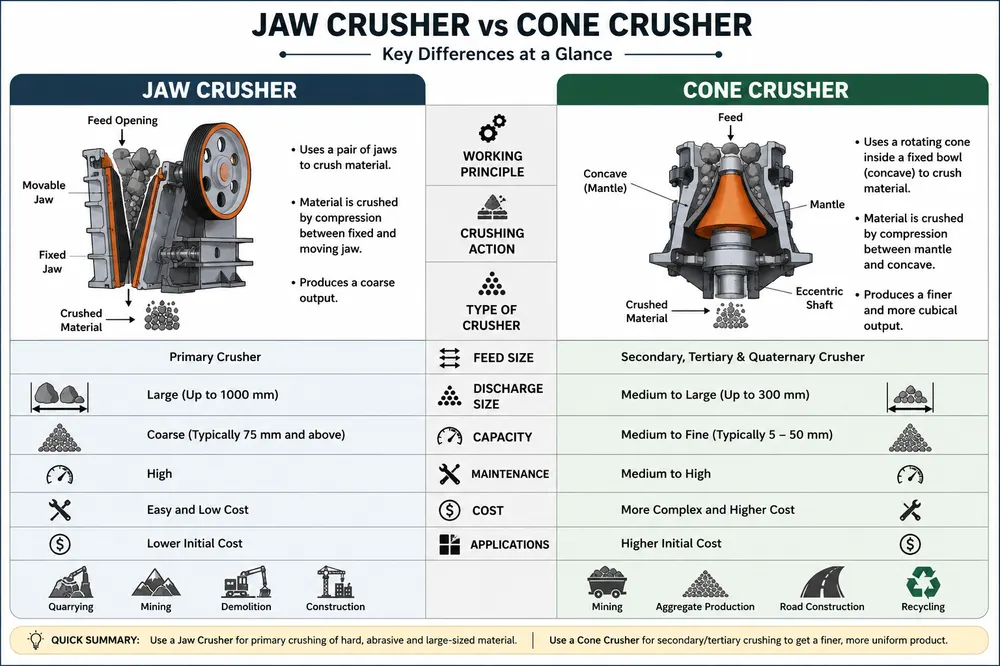
Jaw Crusher vs Cone Crusher
The easiest way to understand the difference is:
Jaw Crusher → Large Feed → Primary Crushing
Cone Crusher → Reduced Feed → Secondary/Tertiary Crushing
The exact capabilities of a crusher depend on its model, configuration, feed material and operating conditions.
What Is a Jaw Crusher?
A jaw crusher is a crushing machine commonly used for primary crushing. It is designed to reduce relatively large rocks and other hard materials into smaller pieces.
A typical jaw crusher has two crushing surfaces: a fixed jaw and a moving jaw. The moving jaw moves toward and away from the fixed jaw. When material enters the crushing chamber, it is compressed between the two jaws and breaks into smaller pieces.
Because jaw crushers can handle relatively large feed material, they are often installed at the beginning of a crushing plant.
How Does a Jaw Crusher Work?
The working principle of a jaw crusher is based mainly on compression.
Material enters the crushing chamber through the feed opening.
The moving jaw moves toward the fixed jaw.
The material is compressed between the jaws.
The rock breaks into smaller pieces.
The material moves downward through the crushing chamber.
Crushed material exits through the bottom of the crusher.
The final size of the material depends on the crusher design, discharge setting, feed characteristics and operating conditions.
Where Are Jaw Crushers Used?
Jaw crushers are commonly used in:
Mining
Quarrying
Aggregate production
Road construction
Construction and demolition
Recycling
Hard-rock processing
Ore processing
They are particularly useful when large material needs to be reduced during the first stage of crushing.
What Is a Cone Crusher?
A cone crusher is commonly used for secondary, tertiary and sometimes quaternary crushing. It is designed to reduce material that has already been processed by an earlier crushing stage.
Instead of using two jaw plates, a cone crusher uses a mantle and concave. The mantle moves in an eccentric or gyrating motion inside the crushing chamber. Material is compressed between the mantle and concave as it passes through the crusher.
This makes cone crushers useful for further size reduction and producing a more controlled product.
How Does a Cone Crusher Work?
A cone crusher works through continuous compression.
Reduced-size material enters the crushing chamber.
The mantle moves within the chamber.
Material is compressed between the mantle and concave.
The material breaks into smaller particles.
The crushed material moves downward.
The material exits through the bottom of the crusher.
The final product depends on factors such as the crusher model, chamber configuration, feed material, crusher settings and operating conditions.
Where Are Cone Crushers Used?
Cone crushers are commonly used in:
Aggregate production
Mining
Quarrying
Road construction
Hard-rock crushing
Ore processing
Sand and gravel processing
Secondary and tertiary crushing
Jaw Crusher vs Cone Crusher: Key Differences
Although both machines use compression to break material, there are several important differences.
1. Crushing Stage
The most important difference is their typical position in the crushing circuit.
A jaw crusher is generally used for primary crushing. It receives relatively large material and reduces it to a size that can be processed by the next stage.
A cone crusher is generally used after primary crushing. It further reduces the material and can help produce the required product size.
A typical crushing circuit may therefore look like:
Large Rock → Jaw Crusher → Cone Crusher → Screening → Finished Aggregate
However, not every crushing plant follows the same arrangement. Crusher selection depends on the material and the requirements of the application.
2. Feed Size
Jaw crushers are commonly selected for applications involving relatively large feed material.
Cone crushers generally work with material that has already been reduced in size.
The actual feed-size capability varies from one crusher model to another, so equipment should always be selected according to the manufacturer's specifications.
If large rocks are fed into equipment that is not designed to handle them, it can affect performance and may increase wear or cause operational problems.
3. Output Size
Jaw crushers are primarily used for initial size reduction, so their output is generally coarser.
Cone crushers are commonly used for further size reduction and can produce a more controlled product size.
When a project requires several aggregate sizes, crushers are usually combined with screening equipment. Oversized material may be returned for additional crushing depending on the plant design.
4. Crushing Mechanism
Jaw and cone crushers both use compression but their crushing chambers are different.
A jaw crusher compresses material between a fixed jaw and a moving jaw.
A cone crusher compresses material between a moving mantle and a stationary concave.
The difference in their crushing action is one reason why they are commonly used at different stages of the crushing process.
5. Product Shape
Product shape can be important when producing aggregates for construction and road projects.
Jaw crushers can produce particles with varying shapes depending on the material, crusher configuration and operating conditions.
Cone crushers can provide good particle shape when correctly selected and operated. However, the final shape is influenced by several factors, including feed characteristics, crusher settings, chamber design and the overall crushing circuit.
Therefore, the crusher should be selected based on the complete application rather than product shape alone.
Jaw Crusher vs Cone Crusher: Advantages and Limitations
Understanding the strengths and limitations of each machine can help when planning a crushing operation.
Jaw Crusher
Advantages
Suitable for primary crushing
Can handle relatively large feed material
Suitable for many tough materials
Commonly used at the beginning of crushing plants
Suitable for mining, quarrying and aggregate applications
Simple compression-based crushing principle
Limitations
Primarily intended for initial size reduction
Usually produces a coarser product than later crushing stages
Additional crushing may be required for smaller product sizes
Jaw dies and other wear components require regular inspection
Cone Crusher
Advantages
Suitable for secondary and tertiary crushing
Useful for further size reduction
Can produce a controlled product size
Suitable for many hard and abrasive materials
Can be used in multi-stage crushing plants
Can provide good particle shape under suitable operating conditions
Limitations
Generally requires appropriately sized feed material
Has a more complex crushing arrangement
Requires proper lubrication and maintenance
Crusher settings and configuration affect performance
Wear components need regular monitoring
Can Jaw and Cone Crushers Be Used Together?
Yes. Using jaw and cone crushers together is common in many crushing plants.
The jaw crusher can perform the primary crushing stage, while the cone crusher handles further size reduction.
For example:
Stage 1: Primary CrushingLarge rocks are processed by a jaw crusher.
Stage 2: Secondary CrushingThe reduced material is processed by a cone crusher.
Stage 3: ScreeningThe crushed material is separated into different sizes.
This combination can be useful when a project requires significant size reduction and controlled aggregate sizes.
The exact crushing circuit depends on the material, required capacity, final product size and plant design.
Which Is Better: Jaw Crusher or Cone Crusher?
There is no universal answer to whether a jaw crusher or cone crusher is better. They are designed to perform different roles.
A Jaw Crusher May Be the Better Choice If:
You need primary crushing.
The feed material is relatively large.
Initial size reduction is required.
The material is hard.
The crusher will be installed at the beginning of the crushing circuit.
A Cone Crusher May Be the Better Choice If:
You need secondary or tertiary crushing.
The feed has already been reduced.
A smaller product is required.
Controlled product sizing is important.
Further crushing of hard or abrasive material is required.
In many applications, the best solution is to use both machines together rather than choosing one over the other.
How to Choose the Right Crusher
Before choosing a jaw crusher or cone crusher, consider the complete application.
1. Material Type
Consider the hardness, abrasiveness, moisture and other characteristics of the material.
Granite, basalt, limestone, ores, concrete and other materials can behave differently during crushing.
2. Feed Size
Determine the maximum size of material entering the crusher and ensure the selected machine is designed to handle it.
3. Required Output Size
Consider the final product size required for your application. If substantial size reduction is required, multiple crushing stages may be necessary.
4. Production Capacity
Determine how much material needs to be processed per hour. The crusher should be appropriately sized for the required production rate.
5. Product Requirements
If the application has specific requirements for aggregate size or shape, consider the complete crushing and screening circuit.
6. Maintenance and Wear
Consider the abrasiveness of the material and the wear components used in the crusher. Regular inspection and timely replacement of wear parts are important for maintaining performance.
Jaw Crusher vs Cone Crusher: Maintenance
Both crushers require regular maintenance to operate effectively.
For a jaw crusher, important components can include jaw dies, bearings, toggle components, lubrication points and other mechanical parts.
For a cone crusher, maintenance can include inspection of the mantle, concave, lubrication system, bearings, hydraulic or protection systems where applicable and other machine-specific components.
Wear parts gradually change during operation. Regular inspection helps identify wear before it significantly affects crushing performance.
The maintenance schedule should always follow the recommendations provided for the specific crusher model.
Conclusion
The difference between a jaw crusher and a cone crusher mainly comes down to their crushing mechanism, typical crushing stage, feed size and role in the overall crushing process.
A jaw crusher is generally used for primary crushing, where relatively large material is reduced to a smaller size. A cone crusher is commonly used for secondary, tertiary, or further crushing, where additional size reduction and controlled product characteristics are required.
Neither machine is universally better. The right choice depends on the material type, feed size, required output, production capacity, product requirements, wear characteristics, and overall plant design.
In many applications, jaw and cone crushers work together as part of a multi-stage crushing circuit. The jaw crusher handles the initial reduction, while the cone crusher performs further crushing before screening and final processing.
For Pithal Machine, choosing the right crushing equipment starts with understanding the specific requirements of the application. By evaluating the material, feed size, capacity, output requirements and complete crushing process, you can select equipment that is properly suited to the job.