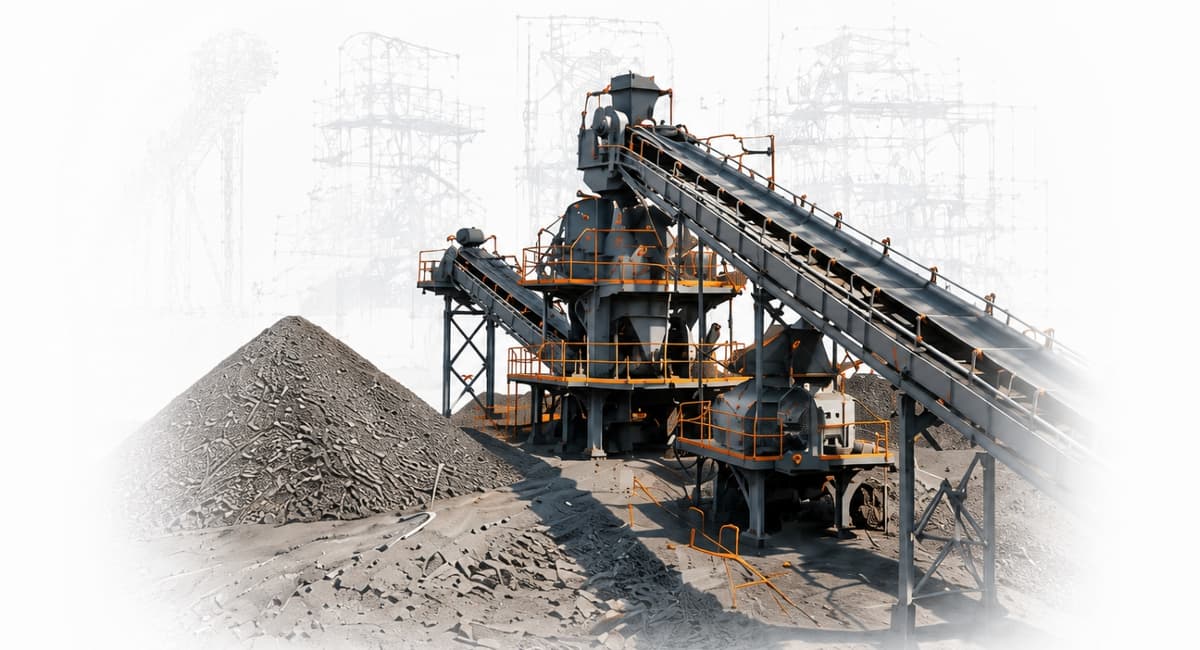
A vibrating screen is a key part of many crushing, screening and mineral processing plants. After material is crushed, it rarely comes out in one uniform size. A vibrating screen separates that material into different size fractions so the required product can move forward while oversized material can be sent back for further crushing.
The basic idea is straightforward: material is fed onto a vibrating screening surface, the vibration spreads and moves the material and particles smaller than the screen openings pass through while larger particles continue toward the discharge end. What makes the process effective is the controlled combination of vibration, gravity, screen design and material movement.
Vibrating screens are used extensively in aggregate production, mining, construction material processing and recycling. They are also commonly installed alongside jaw crushers, cone crushers and VSI crushers to create a complete crushing and screening circuit.
This guide explains how a vibrating screen works, its main components, different types of screens, the role of vibration frequency and amplitude and the factors that determine screening efficiency.
What Is a Vibrating Screen?
A vibrating screen is a mechanical screening machine used to classify bulk material according to particle size. It consists of a screen deck mounted on a supporting frame, a drive and vibration mechanism and supporting components such as springs or other suspension arrangements.
When the machine operates, the screening surface vibrates continuously. Material placed on the deck moves across the screen, giving particles repeated opportunities to pass through the openings.
A vibro screener is another term commonly used for equipment that relies on vibration to separate materials. In industrial applications, however, vibrating screens are generally designed for much higher capacities and continuous operation compared with smaller screening equipment.
The screen opening is particularly important because it determines the approximate size of material that can pass through. A screen can therefore be configured to produce different output sizes depending on the requirements of the crushing or processing plant.
How Does a Vibrating Screen Work?
The working principle of a vibrating screen is based on controlled mechanical vibration and the difference in particle size.
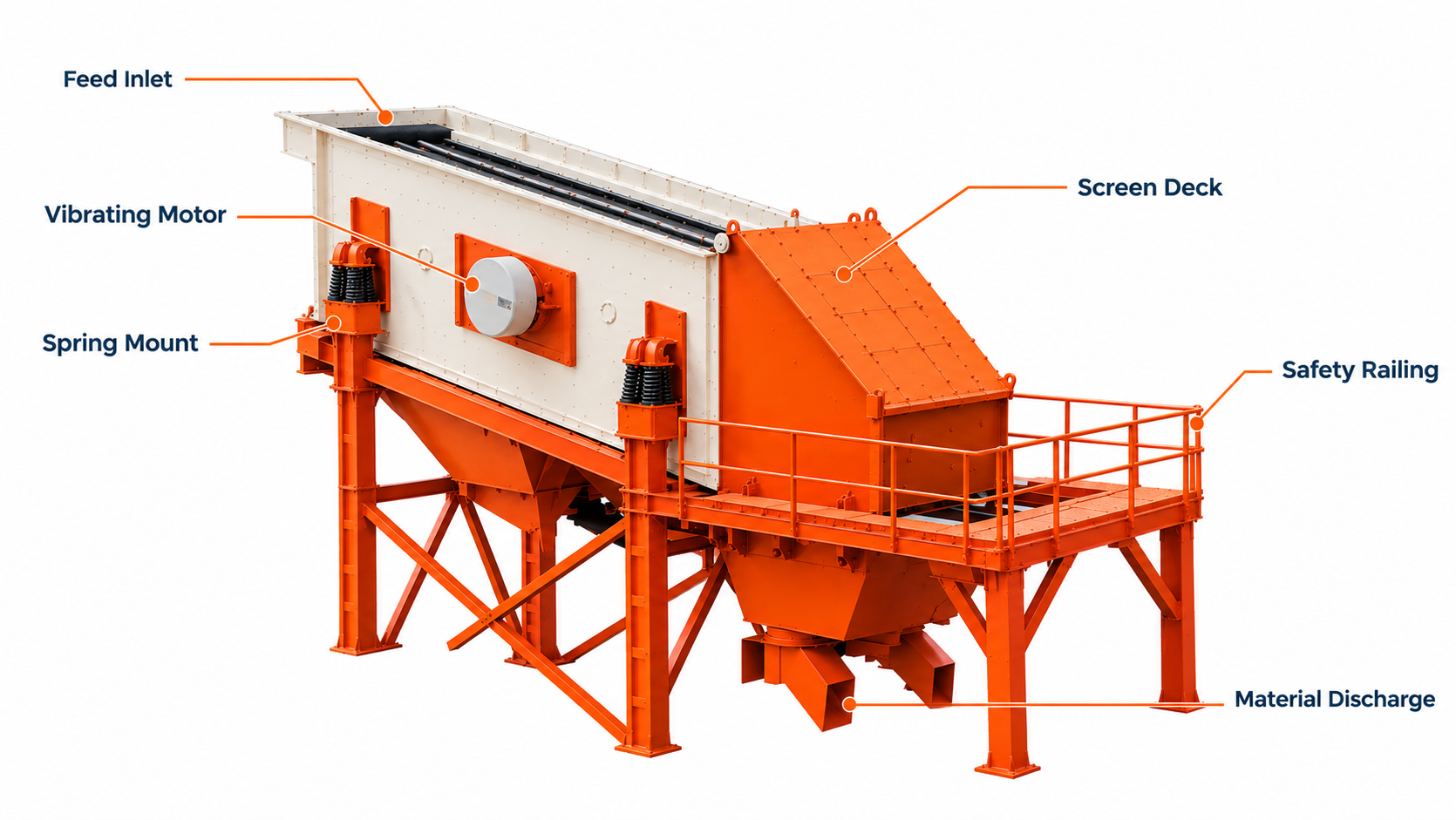
The process begins when material enters the screen through the feed section. A drive motor powers the vibration mechanism, which creates the movement of the screen deck. Depending on the machine design, this movement can be generated using eccentric shafts, unbalanced weights or other mechanical arrangements.
As the deck vibrates, the material is lifted, shifted and transported across the screening surface. The movement helps separate particles by allowing smaller pieces to reach the openings in the screen media.
Material larger than the openings remains on top of the deck and continues moving toward the discharge. Smaller particles fall through the openings and are collected separately.
The process can be simplified as:
Feed Material → Vibration → Particle Stratification → Screening → Size Separation → Separate Discharge
An important part of this process is stratification. Larger particles tend to move toward the upper layer of the material bed while smaller particles work their way downward. Once smaller particles reach the screen surface, they have a better opportunity to pass through the openings.
If the material layer is too deep or the feed rate is too high, smaller particles may not reach the screening surface efficiently. This is why screen capacity is not determined by machine size alone. Feed characteristics, screen design and operating conditions all influence the final result.
Frequency and Amplitude Explained
Two important vibration characteristics are frequency and amplitude.
Frequency refers to how many vibration cycles the screen makes in a given period. In simple terms, it describes how rapidly the screen moves back and forth.
Amplitude refers to the distance the screen moves during vibration. A higher amplitude generally produces a greater movement of material, while a lower amplitude produces gentler movement.
The correct combination depends on the material and screening application. Increasing vibration does not automatically mean better screening. If the movement is too aggressive, material may travel too quickly across the deck and have less time to pass through the openings. If vibration is insufficient, material may move too slowly or build up on the deck.
Good screening comes from matching frequency, amplitude, feed rate and screen design to the material being processed.
Main Components of a Vibrating Screen
Although designs vary between manufacturers and applications, most industrial vibrating screens include several fundamental components.
Screen Deck and Screening Media
The screen deck is the working surface where separation takes place. Screening media can include woven wire mesh, perforated plates and other wear-resistant materials.
The aperture size determines the size of particles that can pass through. Different decks can use different opening sizes to produce multiple fractions.
Vibration Mechanism
The vibration mechanism creates the movement required to transport and separate material. Eccentric shafts or unbalanced masses are commonly used to generate controlled vibration.
The mechanism must be properly balanced because the screen operates continuously under dynamic loads.
Drive Motor
The motor provides the power needed to operate the vibration mechanism. Motor selection depends on the screen's size, design, material load and operating requirements.
Springs and Support Structure
Springs or other suspension components support the vibrating body while allowing it to move. They also help isolate the supporting structure from excessive vibration.
Feed and Discharge Sections
The feed section directs material onto the screening deck, while discharge outlets collect the separated fractions. Proper material distribution at the feed point is important because concentrated feeding can overload one part of the screen.
Types of Vibrating Screens
Vibrating screens are available in different configurations because screening requirements vary from one application to another. The most common designs used in aggregate and mineral processing include linear-motion, circular-motion and multi-deck screens.
Linear Vibrating Screen
A linear vibrating screen uses a linear movement to transport material along the screening deck. The vibration is generally generated through a suitable arrangement of eccentric or unbalanced mechanisms.
Linear screens provide controlled material movement and can be used for a wide range of industrial screening applications. They are particularly useful where material needs to travel in a defined direction while being classified through the screen openings.
Circular Motion Vibrating Screen
Circular-motion vibrating screens move the material in a circular or elliptical pattern. This movement helps distribute the material across the deck and provides effective screening for many aggregate and mining applications.
These screens are often selected for applications that require high-capacity screening and robust operation.
Multi-Deck Vibrating Screen
A multi-deck vibrating screen contains two or more screening surfaces positioned vertically. Each deck can have a different aperture size, allowing several material fractions to be separated in a single machine.
For example, a three-deck screen can separate material into several size ranges without requiring a separate screen for every fraction. This makes multi-deck configurations useful in larger crushing and screening plants.
The appropriate type depends on the material, feed rate, required product sizes, moisture content and overall plant arrangement. There is no single screen design that is ideal for every application.
How Vibrating Screens Work in a Crushing Plant
Vibrating screens are particularly important in crushing plants because crushers produce a range of particle sizes rather than a perfectly uniform product.
Consider a typical circuit where raw stone first enters a primary crusher. The crushed material then moves to a vibrating screen. The screen separates the correctly sized particles from material that is still too large.
In an open circuit, correctly sized material can continue to the next processing stage or final stockpile. In a closed-circuit crushing plant, oversized material is returned to the crusher for another crushing cycle.
The basic process can look like this:
Primary Crusher → Vibrating Screen → Oversize Return → Crusher → Final Screening → Finished Products
This arrangement gives the operator greater control over the final product size. Instead of allowing oversized particles to continue into the finished material, the screen identifies and separates them for further reduction.
For example, a crushing plant producing road aggregate may need several specific size fractions. A multi-deck screen can separate these fractions simultaneously, while oversize material can be directed back to the appropriate crusher.
This is why a vibrating screen for stone crusher applications should be selected as part of the complete crushing circuit rather than treated as an isolated machine.
The screen must be able to handle the crusher's output without becoming a bottleneck. If the screen is undersized or poorly matched to the feed, material can accumulate, separation can deteriorate and the productivity of the entire plant can suffer.
Vibrating Screen vs. Vibrating Sieve
The terms vibrating screen and vibrating sieve are sometimes used interchangeably but they typically describe equipment intended for different operating conditions.
A vibrating sieve is often associated with smaller-scale screening or particle-size analysis. A vibrating sieve shaker, for example, is commonly used in laboratory environments to determine the particle-size distribution of a sample.
Industrial vibrating screens are built for continuous processing and much higher material volumes. They are used in quarries, mines, crushing plants and bulk-material processing facilities.
The distinction is therefore mainly related to scale, capacity and application. Both systems use vibration to assist separation but their construction and operating requirements can be very different.
Applications of Vibrating Screens
Vibrating screens are used wherever bulk materials need to be classified by size. In aggregate plants, they separate crushed stone, gravel and manufactured sand into usable fractions.
In mining operations, vibrating mining screens are used to process ores, minerals, coal and other bulk materials. Mining applications can place significant demands on screening equipment because of heavy feed loads and abrasive material.
Other common applications include construction material processing, recycling, quarrying and mineral processing.
The required screen design depends heavily on the material. Dry, free-flowing aggregate behaves differently from wet, sticky or clay-containing material, so the same screen configuration may not provide the same performance in every application.
Factors That Affect Vibrating Screen Performance
A vibrating screen's performance depends on how well the machine is matched to the material and operating conditions.
Material characteristics are among the most important considerations. Particle size distribution, density, shape, moisture and abrasiveness can all influence how material moves across the deck.
Feed rate also has a major effect. Excessive feed can create a thick material bed, preventing smaller particles from reaching the screen openings. A controlled and evenly distributed feed generally produces better separation.
Screen aperture determines the size of particles that can pass through. Selecting an inappropriate opening can lead to excessive oversize or unwanted fines in the final product.
Moisture and contamination can create additional challenges. Wet or sticky material may clog screen openings, while clay, unwanted debris and other contaminants can interfere with particle movement and reduce the effective screening area.
Vibration settings must also be appropriate. Frequency and amplitude influence material travel speed, stratification and the time available for particles to pass through the deck.
Finally, screen media condition matters. Worn, damaged or blocked screening media can reduce separation accuracy and should be inspected regularly.
How to Improve Vibrating Screen Efficiency
Improving screening performance starts with selecting the right machine for the application. Feed capacity, material characteristics, required product sizes and the number of fractions should all be considered during equipment selection.
Consistent feeding is equally important. Material should be distributed across the available screening area rather than being concentrated in one section.
The vibration settings should be adjusted according to the material and desired separation. Simply increasing vibration to handle more material can sometimes reduce efficiency if particles move across the deck too quickly.
Routine maintenance should include inspection of screen media, bearings, springs, fasteners and the vibration mechanism. Blocked or damaged screen openings should be addressed promptly because small mechanical issues can eventually affect the performance of the complete screening circuit.
Choosing the Right Vibrating Screen Manufacturer
Choosing a reliable vibrating screen manufacturer is important when developing a new crushing plant or upgrading an existing one. The machine should be selected based on actual operating conditions rather than capacity figures alone.
An experienced vibro screen manufacturer should consider factors such as feed material, moisture, particle size, required output, screening stages and integration with crushers and conveyors.
Pithal Machine approaches crushing and screening equipment as part of a complete processing system. Its vibrating screening solutions are intended for applications where consistent material classification is required alongside crushing equipment.
For a crushing circuit, the screen can be considered together with equipment such as the Prime Jaw Crusher, Prime Cone Crusher and Prime VSI. These internal product pages provide natural opportunities for readers to understand how different crushing stages can work together with screening equipment.
For example, a jaw crusher may be used for primary size reduction, followed by screening and further reduction through a cone crusher or VSI, depending on the required product and material characteristics.
This application-based approach helps ensure that the screen is not operating independently but is properly matched to the rest of the plant.
Conclusion
A vibrating screen does much more than simply separate large and small particles. Its controlled vibration creates the movement and stratification needed for efficient size classification, making it an essential part of many aggregate, mining and crushing operations.
The effectiveness of the machine depends on several factors working together. Screen design, aperture size, feed rate, material characteristics, vibration frequency, amplitude and maintenance all influence the final screening result.
In a crushing plant, the role becomes even more important. A well-matched screen can separate correctly sized products while directing oversize material back to the crusher, creating a controlled closed-circuit process and helping the plant maintain consistent output.
For companies planning a new crushing and screening setup, choosing the right equipment manufacturer and matching the screen to the complete processing circuit are important steps. Pithal Machine offers crushing and screening solutions designed around practical material-processing requirements, with equipment that can be integrated with its jaw, cone and VSI crushing solutions.
The right vibrating screen is therefore not simply a machine with a particular capacity. It is a critical part of the complete plant and its design should be selected according to the material, production requirements and final product specifications.