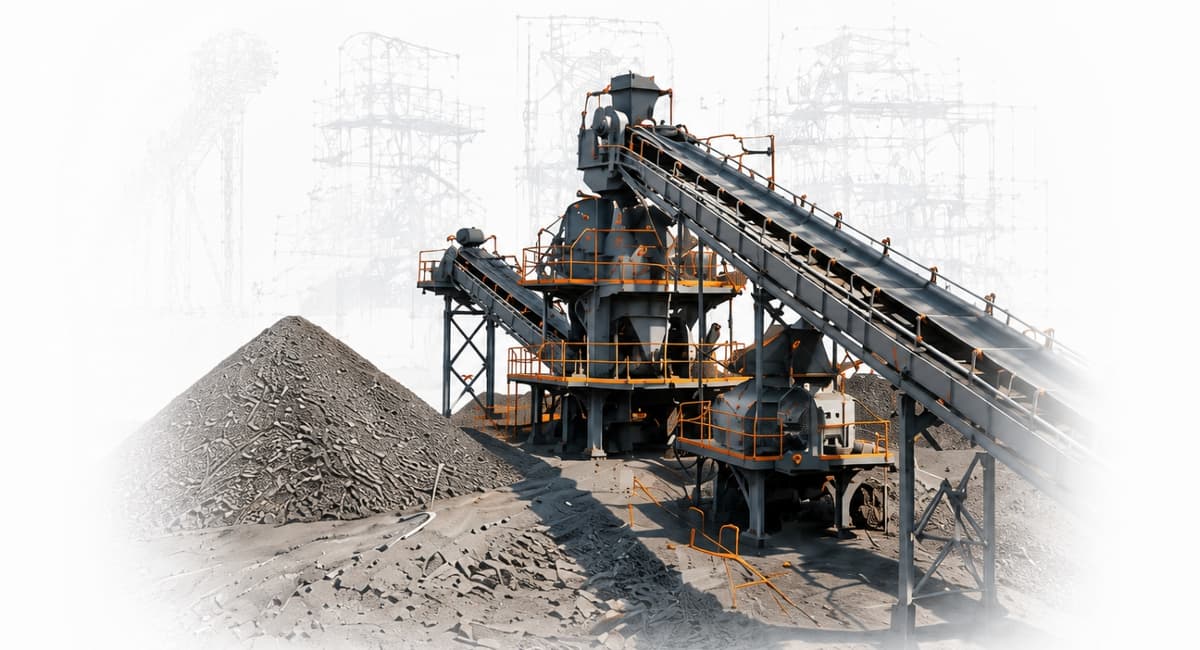
A complete crushing plant is an integrated system designed to transform large rocks and other raw materials into properly sized aggregates for construction, infrastructure, road building and other applications. Unlike a single crusher, a complete crushing plant combines feeding, primary crushing, secondary crushing, screening, conveying and when required, tertiary crushing into one coordinated production process.
The material does not simply enter a crusher and come out as a finished product. It passes through several carefully planned stages with each stage reducing the material further or separating it according to size. The exact arrangement depends on the feed material, required production capacity, maximum feed size and final product specifications.
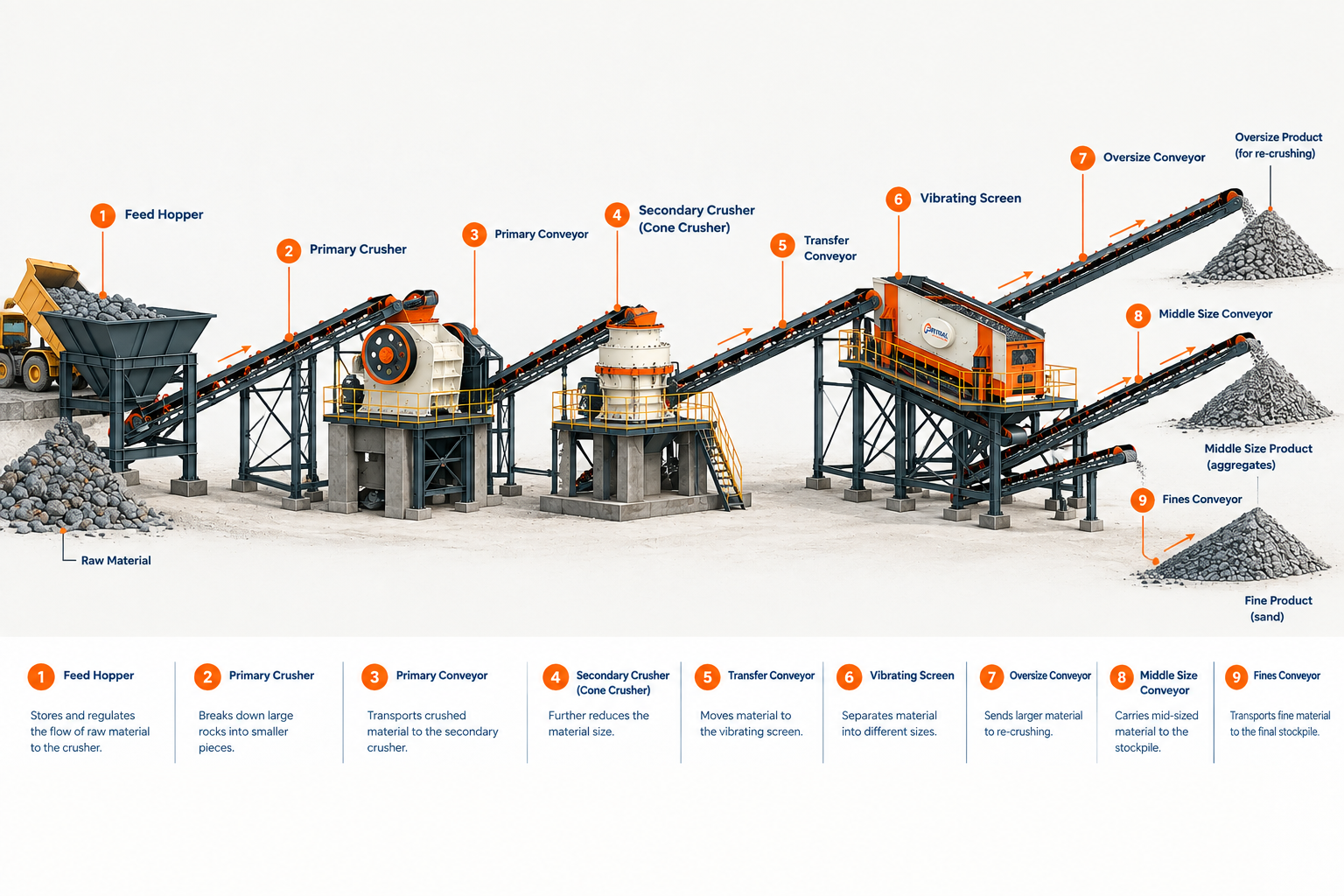
A typical aggregate crushing plant may include a vibrating feeder, jaw crusher, cone crusher, vibrating screen and belt conveyor system. For applications requiring finer material or improved particle shape, a VSI crusher can be added as a tertiary stage. The result is a continuous crushing and screening process that turns large quarry material into consistent final products.
Understanding how this process works makes it easier to see why every piece of crushing equipment must be correctly selected and balanced with the rest of the plant.
What Is a Complete Crushing Plant?
A complete crushing plant is a combination of machines and material-handling systems designed to carry out the complete size-reduction and classification process. It normally begins with the feeding of raw material and ends with screened and separated products ready for stockpiling or dispatch.
The plant may operate in two or three crushing stages depending on the required output. Primary crushing handles the largest material, secondary crushing reduces it further and tertiary crushing is used when finer products or better aggregate shape are required.
Screening is equally important because it determines which material has reached the required size and which material needs further crushing. Belt conveyors connect the different stages and maintain a continuous flow of material through the plant.
Therefore, a complete crushing plant should be viewed as one production system rather than a collection of individual machines.
How Does a Complete Crushing Plant Work?
The basic crushing plant process follows a controlled material flow:
Raw Material → Feeding → Primary Crushing → Conveying → Secondary Crushing → Screening → Tertiary Crushing if Required → Final Screening → Stockpiling
This is a general process rather than a fixed layout. Some plants screen material between crushing stages, while others use surge bins or intermediate stockpiles to regulate the feed between different sections. The final configuration is determined by the material and the products that need to be produced.
The main principle remains the same: each stage reduces or separates the material so that the next stage receives a suitable feed. This staged approach prevents one crusher from having to perform the entire size-reduction process in a single pass.
Stage 1: Feeding the Raw Material
The crushing plant process begins when raw material from a quarry, mine or other source is transported to the plant. Large rocks are unloaded into a feed hopper or receiving area.
From the hopper, a vibrating feeder controls how quickly material enters the primary crusher. This controlled feeding is important because the crusher needs a consistent supply of material to operate efficiently.
A vibrating grizzly feeder can also separate smaller particles and unwanted fines before the material reaches the primary crusher. Removing some of these fines at the beginning can reduce unnecessary loading on the crusher and help maintain a more stable feed.
The feeding stage therefore does much more than simply move rock into the plant. It controls the starting point of the entire production flow. An irregular or excessive feed can affect crusher performance, downstream screening and overall plant capacity.
Stage 2: Primary Crushing With a Jaw Crusher
After feeding, the material enters the primary crushing stage. A jaw crusher is commonly used for primary crushing because it is designed to handle large and coarse feed material.
Inside the jaw crusher, material is compressed between a fixed jaw and a moving jaw. As the moving jaw approaches the fixed jaw, the rock is broken into smaller pieces. The crushed material then moves downward through the crusher and exits through the discharge opening.
The purpose of primary crushing is to make the large quarry feed small enough for the next stage. It is not normally intended to produce the final aggregate size.
The size of the primary-crusher output depends on factors such as the feed characteristics and crusher settings. Once the material leaves the jaw crusher, it is transported toward the next part of the crushing circuit, usually by a belt conveyor.
For Pithal Machines, the Prime Jaw Crusher can be positioned as the primary crushing equipment within an appropriately designed crushing circuit.
Stage 3: Conveying and Intermediate Material Handling
After primary crushing, the material must move efficiently toward secondary processing. Belt conveyors perform this job by continuously transferring crushed material between different machines, stockpiles, bins and screening units.
A conveyor is not simply a transport system. Its capacity needs to match the material flow from the preceding stage and the requirements of the equipment that follows it. If one section cannot handle the required flow, it can create a bottleneck for the entire crushing plant.
Some complete crushing plants also use an intermediate stockpile or surge bin between primary and secondary crushing. This provides a buffer between stages and can help maintain a more controlled feed to downstream equipment.
Good material handling keeps the crushing circuit connected and allows the different machines to operate as one system.
Stage 4: Secondary Crushing
The material then enters secondary crushing, where it is reduced further. Cone crushers and impact crushers are commonly used at this stage, depending on the rock characteristics, required reduction and final product requirements.
A cone crusher uses compression between the mantle and concave to reduce the size of the material. It is particularly useful for hard and abrasive materials and can produce a controlled crushed product for further screening.
The secondary crushing stage is important because it brings the material closer to the required aggregate sizes. Crusher settings can be adjusted according to the desired output but the final result still depends on the interaction between crushing and screening.
Pithal's Prime Cone Crusher can be relevant in this part of a multi-stage aggregate crushing plant where further size reduction and controlled product generation are required.
Stage 5: Screening and Material Classification
After secondary crushing, the material usually reaches a vibrating screen. Screening separates the crushed material into different size fractions.
A vibrating screen works by moving material across a screening surface. Smaller particles pass through the openings, while larger particles remain on the screen and move toward the discharge area.
The material that passes through the screen is known as the undersize, while material that remains because it is too large is known as the oversize. The undersize may already meet the required specification and can move toward the next stage or final product stockpile.
Oversize material normally needs additional crushing. It can be sent back to the appropriate crusher through a return conveyor, creating a closed-circuit crushing system.
This makes the vibrating screen one of the most important pieces of crushing equipment because it controls product classification rather than simply removing unwanted material.
Stage 6: Tertiary Crushing and the Role of a VSI Crusher
Not every crushing plant requires tertiary crushing. A simpler plant may produce the required aggregate sizes after primary and secondary crushing. However, applications that require finer material, manufactured sand or improved particle shape may need an additional stage.
A VSI crusher or Vertical Shaft Impactor can be used as a tertiary or shaping stage after the material has already been reduced to a suitable feed size. A VSI uses high-speed impact to break and shape particles rather than relying primarily on compression.
This makes a VSI particularly useful when the crushing plant needs improved particle shape or finer products. In manufactured sand applications, it can help process suitable feed material into a more controlled fine product.
Pithal's Prime VSI crusher can therefore be integrated into a suitable tertiary crushing circuit where fine crushing or aggregate shaping is required.
Stage 7: How Closed-Circuit Crushing Works
Closed-circuit crushing is one of the key principles behind controlled aggregate production.
After crushing, the material passes through a vibrating screen. Material that meets the required size is separated and sent toward the appropriate product stream. Material that is still too large remains as oversize and is returned to the crusher through a conveyor.
The material is crushed again and sent back to the screen. This cycle continues until the particles reach the required size.
In simple terms, the circuit works as:
Crusher → Screen → Correct Size Product + Oversize → Return to Crusher
This arrangement allows the plant to control the final product more effectively and prevents oversized material from unnecessarily reaching the finished-product stockpile. Closed-circuit screening and return conveyors are common features of multi-stage crushing systems.
Stage 8: Final Screening and Product Separation
Once the material has passed through the required crushing stages, it reaches final screening. At this point, the objective is to separate the material into the specific product sizes required by the customer or application.
A multi-deck vibrating screen can produce several size fractions from one feed stream. Depending on the plant configuration, the final products may include different coarse and fine aggregate sizes as well as manufactured sand.
Accurate final screening is important because aggregate specifications often depend on particle-size distribution. If the screen is not correctly selected or operated, different products can become mixed or the plant may send too much oversize back into the crushing circuit.
Pithal's Vibrating Screens can be used as part of this classification stage, depending on the required capacity, screening area and product sizes.
Stage 9: Conveying and Stockpiling the Final Product
After final screening, correctly sized material is transported by belt conveyors toward separate stockpiles, storage bins or other collection points.
Each product stream should remain separated so that different aggregate sizes do not mix. For example, a plant producing multiple aggregate grades may use individual conveyors to direct each fraction to its designated stockpile.
Stockpiling is the final material-handling stage before the aggregate is transported for use. The finished products may be used for concrete, asphalt, road construction, infrastructure projects, manufactured sand and other applications depending on their specifications.
At this stage, the original large quarry rock has passed through a controlled sequence of feeding, crushing, screening and conveying to become a usable final product.
How All Crushing Plant Equipment Works Together
The efficiency of a complete crushing plant depends on how well its individual components work together. A high-capacity crusher alone cannot guarantee high production if the feeder, screen or conveyor cannot handle the same material flow.
The vibrating feeder controls the feed. The jaw crusher performs primary size reduction. The cone crusher or another suitable machine performs secondary crushing. Vibrating screens classify the material, while conveyors connect each stage and return oversize when the circuit requires it.
Where finer products or improved shape are required, a VSI crusher can be incorporated into the tertiary stage.
This integrated approach is what makes a complete crushing and screening plant different from operating individual crushers independently. The entire circuit has to be balanced around the required feed rate, product sizes and production target.
What Factors Affect Crushing Plant Performance?
The performance of a crushing plant depends first on the characteristics of the material being processed. Rock hardness, abrasiveness, moisture, feed size and material composition can influence crusher selection and operating conditions.
Production capacity is another important factor. A plant designed for a smaller output will require a different combination and size of crushing equipment from a large aggregate crushing plant.
The required final products also determine the circuit. A plant producing one coarse aggregate may need fewer stages than a plant producing several aggregate sizes and manufactured sand.
Screening capacity, conveyor capacity, crusher settings, feed consistency and maintenance also affect the overall performance of the plant. This is why crushing plant design should begin with the required final products and feed characteristics rather than selecting machines individually.
Conclusion
A complete crushing plant is a coordinated production system in which every stage has a specific purpose. The process begins with controlled feeding of raw material and continues through primary crushing, material transfer, secondary crushing, screening and when required, tertiary crushing with a VSI crusher.
The vibrating screen separates material according to size, while closed-circuit conveyors return oversize material for further crushing. Correctly sized material is then transported to separate stockpiles as the final product.
The key to efficient aggregate production is not simply using powerful crushing equipment. The feeder, crushers, screens and conveyors must be correctly matched so that material can move through the plant without unnecessary bottlenecks or interruptions.
When the complete circuit is properly designed, a crushing and screening plant can provide consistent production, controlled product sizes and efficient material handling from the initial feed to the final aggregate.