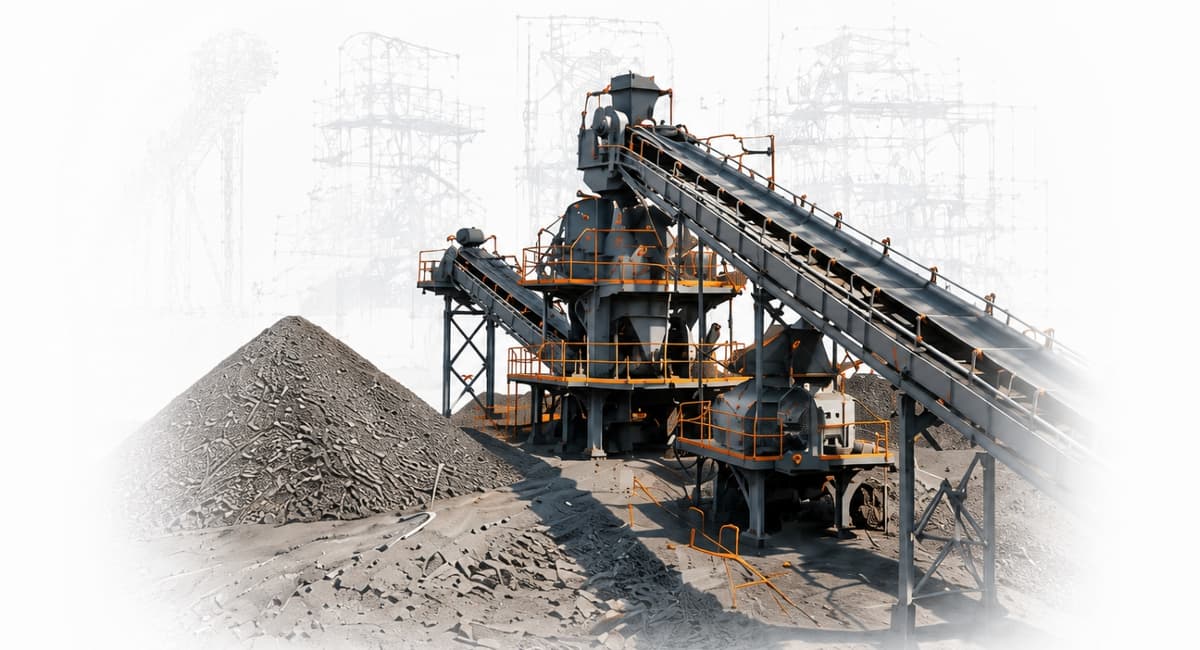
A crushing plant is a connected system where every stage needs to work together for consistent production. Crushers reduce the size of raw material, vibrating screens separate it into different sizes and a conveyor system moves material between these stages. Without reliable material handling, even a high-capacity crushing plant can experience bottlenecks, excessive handling and unnecessary downtime.
A conveyor system for crushing plants is designed to transport materials such as aggregates, limestone, granite, basalt and other bulk materials continuously from one processing stage to another. Depending on the plant layout, conveyors can transfer material from a feeder to a jaw crusher from a crusher to a vibrating screen between secondary and tertiary crushing stages or from the final screen to stockpiles.
This guide explains how a crushing plant conveyor works, the main types and components, how to select the right system, what affects conveyor belt price and how conveyors contribute to overall plant performance.
What Is a Conveyor System for a Crushing Plant?
A conveyor system is a mechanical material-handling arrangement used to move bulk material continuously between two or more points. In crushing plants, it connects different pieces of processing equipment and helps maintain a steady flow of material throughout the circuit.
A typical aggregate crushing process may look like this:
Feeder → Jaw Crusher → Conveyor → Vibrating Screen → Cone Crusher → Conveyor → Final Products
The exact arrangement depends on the required production capacity, material characteristics and final product sizes.
For example, material may be reduced in size by a jaw crusher before a conveyor transfers it to a vibrating screen. The screen separates the material into different fractions. Correctly sized material can move toward stockpiles, while oversize material can be conveyed to a cone crusher for further reduction. After secondary crushing, the material may return to the screen in a closed circuit.
This is why conveyor equipment should be considered part of the complete crushing circuit rather than as separate material-handling machines.
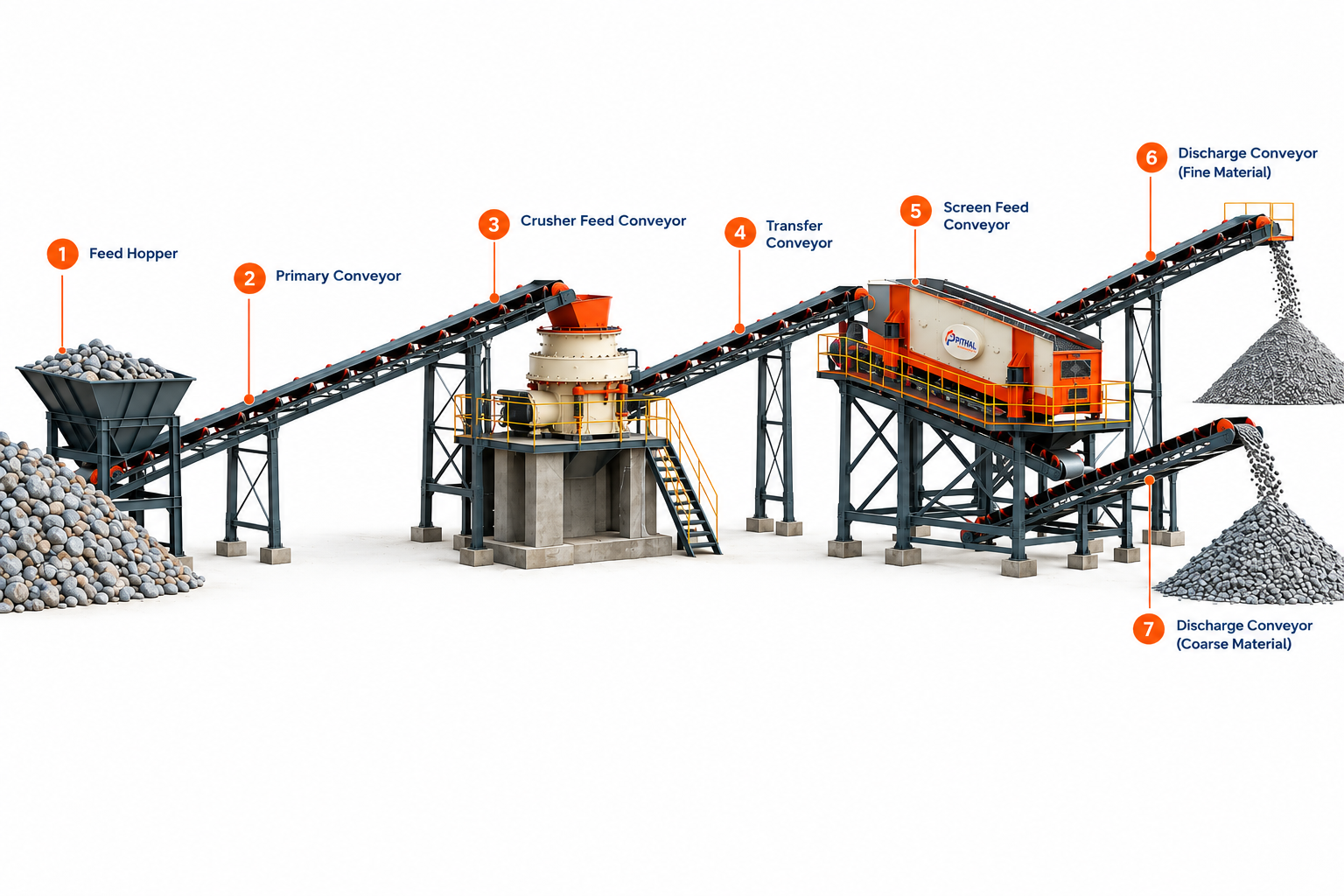 How Does a Conveyor Belt Work?
The most common arrangement in crushing plants is a belted conveyor, which uses a continuous belt running around pulleys and supported by rollers or idlers.
Material enters the belt at the loading point, usually through a feed chute or transfer chute. A motor and gearbox drive the drive pulley, causing the belt to move. As the belt travels along the carrying side, troughing idlers support the belt and help keep bulk material centred.
When the belt reaches the head pulley, it changes direction and the material leaves the belt at the discharge point. The empty belt then travels back along the return rollers toward the tail pulley.
The basic process is:
Loading → Transport → Discharge → Return
The conveyor's capacity depends on several factors, including belt width, belt speed, material density, loading profile and the characteristics of the material being transported.
In a crushing plant, the conveyor should be matched to the actual material flow from the equipment feeding it. If the conveyor cannot handle the crusher's output, material can accumulate at transfer points and restrict production. On the other hand, an unnecessarily oversized conveyor can increase equipment and operating costs.
Where Are Conveyors Used in Crushing Plants?
Conveyors are used throughout the crushing and screening circuit. Their location and configuration depend on the plant design.
A feed conveyor or transfer arrangement can move material from one stage to another, while a primary discharge conveyor may carry material away from a jaw crusher. After screening, separate conveyors can transport different product sizes to designated stockpiles.
In a closed-circuit plant, one conveyor can return oversize material from the screen to a cone crusher. Once the material has been reduced sufficiently, it returns to the screening stage.
VSI crushers can also be integrated into circuits where additional particle shaping or manufactured sand production is required. In such applications, conveyors provide controlled material transfer between the crushing and screening stages.
This interconnected arrangement helps maintain continuous production and reduces unnecessary movement by loaders and trucks within the processing area.
Types of Conveyors Used in Crushing Plants
Different applications require different conveyor configurations.
Fixed Belt Conveyor
Fixed conveyors are permanently installed in a specific position. They are commonly used in stationary crushing plants where the crushers, screens and stockpiles have a defined layout.
Because the conveyor route is fixed, the system can be designed specifically around the plant's material flow.
Mobile Conveyor
Mobile conveyors can be repositioned as the crushing operation changes. They are useful for mobile and semi-mobile crushing applications where stockpile locations or processing positions may change.
Their flexibility can reduce the need to repeatedly relocate other material-handling equipment.
Inclined Conveyor
Inclined conveyors transport material between different elevations. They may be used to carry crushed material from a lower processing stage to an elevated screen or stockpile.
The inclination needs to be selected according to the material because excessive angles can increase rollback and spillage.
Transfer Conveyor
Transfer conveyors are used to move material from one processing stage to another, often between crushers, screens and other conveyors. They are an important part of multi-stage crushing circuits where several pieces of equipment operate together.
Radial Stacker
Radial stackers distribute finished material over a larger stockpile area. Their ability to change the discharge position can improve stockpile utilisation and reduce the need for additional loading equipment.
How to Choose the Right Conveyor System
Choosing the right conveyor machine starts with understanding the material and the crushing circuit rather than simply selecting a belt size.
Material Characteristics
Consider the material's size, density, moisture content and abrasiveness. Hard aggregates such as granite and basalt can produce high wear, while large feed particles can create considerable impact at loading points.
These characteristics influence the belt specification, idler arrangement, chute design and overall conveyor construction.
Capacity
Conveyor capacity should be compatible with the actual production rate of the crushing plant.
For example, if a crusher is consistently producing a high volume of material but the conveyor is undersized, the conveyor can become a bottleneck. The complete circuit should therefore be evaluated rather than sizing each conveyor independently.
Belt Width and Speed
Belt width and speed determine how much material the conveyor can carry. Wider belts generally provide greater carrying capacity, while belt speed influences the rate at which material moves through the system.
The correct combination depends on production requirements, material characteristics and plant layout.
Length and Inclination
Long conveyors require careful consideration of drive power, belt tension and structural support. Inclined conveyors also require appropriate consideration of material retention and belt grip.
Plant Layout
The conveyor route should provide a smooth flow between equipment while avoiding unnecessary transfers. Loading and discharge points should be positioned to reduce spillage and excessive impact.
Maintenance access should also be considered during the layout stage. A conveyor that is difficult to inspect can increase maintenance time and plant downtime.
Common Conveyor Problems and Maintenance
Regular maintenance helps prevent small conveyor problems from becoming major production interruptions.
Belt misalignment is a common issue and can result from incorrect pulley or idler alignment, uneven loading or material accumulation. If the belt repeatedly moves toward one side, the underlying cause should be investigated.
Belt slipping can occur because of insufficient tension, excessive loading or drive-related problems. Damaged or seized rollers can increase resistance and accelerate belt wear.
Routine inspections should include the belt, idlers, pulleys, bearings, fasteners and tensioning system. Transfer points should also be kept clean so that accumulated material does not interfere with moving components.
Preventive maintenance is particularly important in continuous crushing operations because a conveyor failure can interrupt material flow to several downstream machines.
Choosing the Right Conveyor Manufacturer
The right conveyor manufacturer should understand the requirements of crushing and screening applications rather than simply supplying a standard conveyor.
A capable conveyor system manufacturer should evaluate the complete circuit, including crusher capacity, screen output, material characteristics, conveyor length, inclination and plant layout.
When selecting a conveyor belt manufacturer, consider the quality of the belt and other components, availability of replacement parts, technical support, customisation capability and after-sales service.
For a crushing plant, the best conveyor is not necessarily the most complex one. It is the one correctly matched to the material, production requirements and equipment around it.
Conveyors as Part of a Complete Crushing Solution
A conveyor should be selected with the entire crushing and screening circuit in mind.
For example, a plant may use a jaw crusher for primary size reduction, followed by a conveyor that transfers the material to a vibrating screen. Oversize material can then move through a conveyor to a cone crusher for secondary crushing before returning to the screening stage.
Where particle shaping or manufactured sand is required, a VSI crusher can be incorporated into the circuit with appropriate conveying arrangements.
This integrated approach helps balance material flow between machines and reduces the risk of one part of the plant becoming a bottleneck.
Pithal Machine's crushing and screening equipment can be considered as part of such integrated material-processing solutions. Its equipment range includes jaw crushers, cone crushers, VSI crushers and vibrating screens, allowing plant configurations to be developed around different aggregate and material-processing requirements.
Final Thoughts
A reliable conveyor system is an essential part of an efficient crushing plant. It connects crushers, screens and stockpiles while maintaining a controlled flow of material through the processing circuit.
Selecting the right conveyor requires consideration of material characteristics, production capacity, belt width, speed, conveyor length, inclination, transfer points and maintenance requirements. The system should also be designed around the actual output of the crushing and screening equipment.
For aggregate, mining and manufactured sand applications, choosing the right conveyors and conveying system can help reduce unnecessary material handling and support consistent plant performance.
By integrating the conveyor with the right crushers and screening equipment, manufacturers and plant operators can create a balanced material-processing circuit designed for reliable and efficient operation.