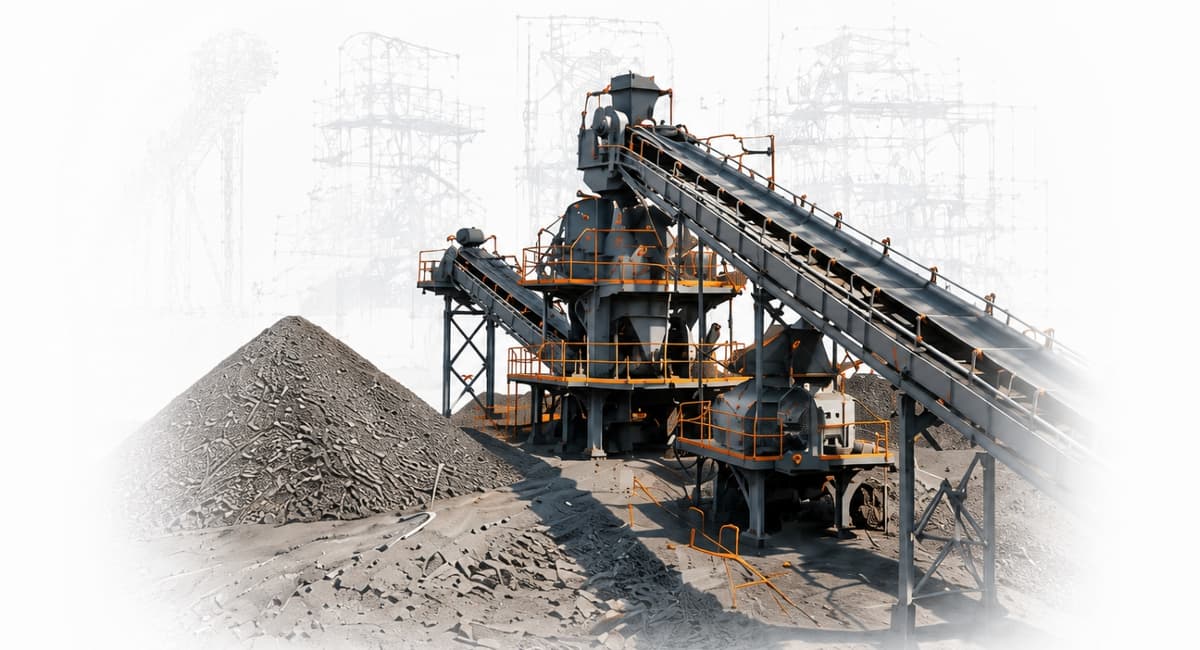
Closed-circuit crushing is a crushing process in which material is screened after it leaves the crusher and oversized particles are sent back for another crushing cycle. The process continues until the material reaches the required size, helping producers achieve consistent aggregate gradation, reduced oversize material and better control over final product quality.
For quarry owners, mining businesses, road contractors and manufactured sand producers, closed-circuit crushing is often the preferred choice when product specifications are strict. At Pithal Machines, we understand that a crushing plant is not only about breaking rock but it is about producing saleable, uniform and high-quality material at the right operating cost.
What Is Closed-Circuit Crushing?
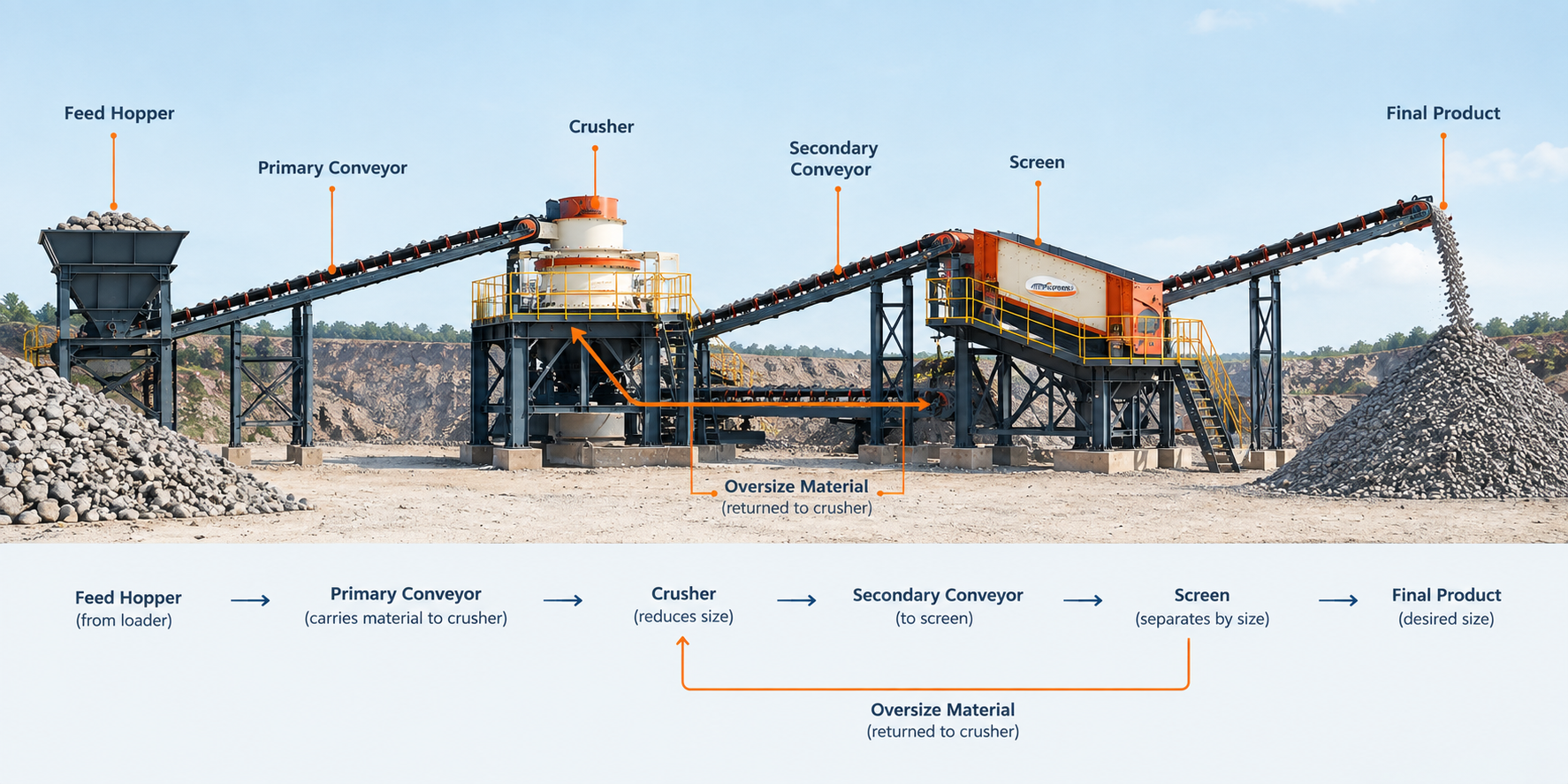
A closed-circuit crushing plant is a setup where a crusher works together with a screening machine. Fresh material enters the crusher, where it is reduced in size. The crushed material then moves to a vibrating screen or other sizing equipment.
The material that meets the required size passes through the screen and becomes the final product. Material that is still too large is called oversize material. Instead of being sent to the stockpile, this oversize material is returned to the crusher for another pass.
The process can be understood simply:
Fresh Feed → Crusher → Vibrating Screen → Finished Product + Oversize Return to Crusher
This repeated cycle is called a “closed circuit” because the oversized material remains within the crushing and screening loop until it reaches the required size. Closed-circuit crushing is widely used in aggregate production, quarry operations, mining plants, construction material processing and manufactured sand production.
How Does a Closed-Circuit Crushing Plant Work?
A typical closed-circuit crushing and screening plant includes a feeder, crusher, conveyor system, vibrating screen, return conveyor and stockpile arrangement. The exact configuration depends on the feed material, required capacity, desired product size and end-use application.
The process begins when raw material is fed into a crusher. In most plants, a jaw crusher handles the primary crushing stage, especially when large rocks or blasted quarry material must be reduced. The output then moves to a secondary cone crusher, impact crusher or vertical shaft impactor, depending on the target product and rock characteristics.
After crushing, the material reaches a vibrating screen. The screen separates the material according to the selected mesh size. Material smaller than the screen opening is accepted as finished product or transferred to the next stage. Larger material is carried through a return conveyor and sent back to the crusher.
This system ensures that only properly sized aggregate leaves the plant. Rather than allowing oversized particles to reach the final stockpile, the closed-circuit arrangement automatically corrects them through recirculation.
Closed-Circuit vs Open-Circuit Crushing
When Is Closed-Circuit Crushing Used?
Closed-circuit crushing is used when the final material must meet a specific size range or grading requirement. It is commonly selected for secondary and tertiary crushing stages because this is where aggregate producers need better control over final product quality.
For example, a road contractor may need consistent 20 mm, 10 mm and 6 mm aggregates for asphalt or concrete production. An open-circuit crusher can produce material quickly but it may also allow oversize particles to enter the stockpile. In a closed-circuit crushing plant, the vibrating screen separates the required size fractions while sending larger particles back for re-crushing.
This arrangement is especially valuable in applications where aggregate quality directly affects the strength, performance and reliability of the final construction project.
Closed-circuit crushing is commonly used in quarry and aggregate plants producing concrete aggregates, road construction materials, railway ballast, crushed stone, manufactured sand and high-quality stone dust. It is also used in mining operations when ore must be reduced to a controlled size before moving to grinding mills or mineral processing equipment.
Closed-Circuit Crushing for Aggregate Production
In aggregate production, consistency is everything. Ready-mix concrete plants, infrastructure contractors, paver block manufacturers and asphalt plants need material that meets defined size and shape standards. Even small variations in aggregate gradation can affect concrete strength, asphalt compaction and production efficiency.
A closed-circuit cone crusher is commonly used to produce 20 mm, 12 mm, 10 mm and 6 mm aggregates. The screen separates these fractions and ensures that larger material goes back to the crusher. This gives the operator more control over the final product and reduces the amount of off-spec material reaching the market.
For a quarry owner, this means improved customer confidence. When buyers receive uniform material load after load, they are more likely to continue purchasing from the same supplier. Consistency can become a strong competitive advantage, particularly in regions where infrastructure, highways, real estate, and RMC demand are growing.
Pithal Machines can help aggregate producers select crushing and screening equipment based on output capacity, feed size, rock hardness, required gradation and available site area. A properly designed crushing circuit helps reduce unnecessary rehandling, improve screening efficiency and deliver better-quality aggregate.
Closed-Circuit Crushing for Manufactured Sand
Manufactured sand, also known as M-sand, requires close control over particle size distribution. The final sand should contain the right proportion of fines, avoid excessive oversize particles and maintain a shape suitable for concrete and plaster applications.
A closed-circuit crushing plant is highly effective for M-sand production because it separates material continuously. Oversized particles are returned to the crusher, while correctly sized material moves toward the final sand processing stage. In many plants, a vertical shaft impact crusher or VSI crusher is used in the tertiary stage to improve particle shape and produce cubical sand.
The use of a screen in the circuit helps maintain product consistency. This is important because M-sand buyers often evaluate fineness modulus, grading zone, dust content and shape before accepting material. With a properly configured closed circuit, producers can minimize waste, reduce oversize and improve the market value of their sand.
For Pithal Machines customers, the goal is not simply to increase tonnage. The goal is to produce M-sand that performs well in real construction applications and meets the expectations of contractors, builders and concrete producers.
Key Benefits of Closed-Circuit Crushing
Closed-circuit crushing plants improve product quality, reduce oversized material and provide greater control over aggregate production.
1. Better Product Gradation
One of the biggest advantages of a closed-circuit crushing plant is improved product gradation. In this setup, the crushed material passes through a vibrating screen before becoming the final product. Particles that meet the required size are separated, while oversized material is sent back to the crusher for further reduction.
This screening and recirculation process helps operators maintain a more consistent product size, making closed-circuit crushing suitable for applications that require controlled aggregate gradation.
2. Reduced Oversized Material in the Final Product
Closed-circuit crushing helps reduce the amount of oversized material reaching the finished aggregate stockpile. In an open-circuit crushing plant, particles larger than the required size may pass through the system and mix with the final product.
With a closed-circuit arrangement, the vibrating screen separates these oversized particles and returns them to the crusher. This improves product consistency and helps maintain the required quality standards for construction and other aggregate applications.
3. More Efficient Use of Crusher Capacity
Another important benefit is the efficient use of crusher capacity. The screening stage separates material that has already reached the required size from particles that still need further crushing.
Instead of sending all material through the crusher repeatedly, the circuit focuses additional crushing on oversized particles. This can support more efficient operation, particularly in fine crushing applications and manufactured sand production, where controlling the final particle size is important.
4. Greater Flexibility in Production
A closed-circuit crushing plant gives operators greater flexibility to adjust production according to material requirements and market demand. Crusher settings, screen media, feed rate and other operating parameters can be adjusted to influence the final output.
For example, a plant may prioritize 20 mm aggregate for construction projects during one period and increase M-sand production during another. This flexibility helps crushing plant operators respond to changing customer requirements while maintaining control over product size and quality.
Important Factors in Closed-Circuit Plant Design
Effective closed-circuit crushing plant design requires the right combination of crushers, vibrating screens, conveyors and operating parameters to achieve consistent production and product quality.
1. Feed Material Characteristics
The characteristics of the feed material play an important role in closed-circuit crushing plant performance. Rock hardness, abrasiveness, moisture content, clay content, feed size and required output all influence equipment selection and plant capacity.
Hard and abrasive materials may require robust crushing equipment, while wet or clay-rich feed can affect screening efficiency and material flow. Understanding these conditions helps engineers design a crushing and screening plant that operates reliably under actual site conditions.
2. Vibrating Screen Selection and Capacity
Vibrating screen selection is one of the most important factors in closed-circuit plant design because the screen controls the separation of finished material from oversized particles.
If the screen does not have sufficient capacity, the entire circuit may become restricted. An undersized screen can lead to material buildup, reduced separation efficiency and excessive recirculating load. Proper selection of screen deck configuration, mesh size, screen angle and vibration settings helps maintain smooth material flow and consistent product gradation.
3. Crusher Selection for the Application
The crusher must be matched to the material characteristics, required reduction ratio and final product specifications. Different crusher types are suited to different stages and applications within a closed-circuit crushing plant.
Cone crushers are commonly used for hard and abrasive rock in secondary and tertiary crushing. Impact crushers can be suitable for softer rock and certain recycling applications. VSI crushers are often selected when improved particle shape and manufactured sand production are required.
Choosing the right crusher helps maintain product quality while supporting efficient operation throughout the crushing circuit.
4. Conveyor System and Recirculating Load
Conveyor design is another important consideration in a closed-circuit crushing plant. Return conveyors must be capable of handling the recirculating load from the vibrating screen and delivering oversized material back to the crusher without unnecessary delays.
Proper conveyor sizing, transfer-point design and material flow management help reduce spillage, bottlenecks and interruptions. The conveyor system should be designed to work in coordination with the crusher and screen to maintain a balanced production flow.
5. Integrated Plant Design by Pithal Machines
A well-designed closed-circuit crushing and screening plant considers the crusher, vibrating screen and conveyors as one connected system. Each component must work together to achieve the required capacity, product size and operational efficiency.
At Pithal Machines, crushing plant design focuses on understanding material characteristics, production requirements and equipment compatibility. This integrated approach helps develop crushing and screening solutions suited to mining, aggregates and construction applications.
Is Closed-Circuit Crushing Worth the Investment?
Closed-circuit crushing usually requires a higher initial investment than an open-circuit setup because it needs a screen, additional conveyors, electrical components,and structural arrangements. However, the long-term value often justifies the cost for producers targeting premium aggregate, M-sand, asphalt material or concrete-grade stone.
The actual decision depends on the market. If customers only need rough fill material and have no strict size requirement, an open-circuit plant may be sufficient. But if a producer supplies RMC plants, contractors, infrastructure projects or quality-sensitive buyers, closed-circuit crushing can help meet their specifications consistently.
It can also reduce the cost of rejected loads, reprocessing, manual sorting and customer complaints. Over time, consistent material quality may allow a quarry or crushing plant to build stronger relationships with high-value customers.
Closed-Circuit Crushing Solutions from Pithal Machines
Pithal Machines provides crushing and screening solutions designed for quarrying, aggregate production, construction material processing and manufactured sand applications. The right closed-circuit configuration depends on your production capacity, feed material, site layout, desired aggregate sizes and long-term business objectives.
Whether you need a plant for 20 mm and 10 mm aggregate, railway ballast, crusher dust or M-sand, a properly designed closed circuit can help improve product quality and reduce oversize material. Pithal Machines focuses on practical plant layouts that support efficient material movement, reliable screening, easier maintenance and consistent output.
If your business needs precise aggregate grading, better particle shape and stronger control over final product quality, a closed-circuit crushing and screening plant is a smart long-term investment.