
Think about a stone quarry where large rocks are extracted every day. Those rocks cannot be used directly for road construction, concrete or other building work. They first need to be broken into smaller pieces and separated according to size. This is where stone crushers play an important role.
Stone crushing is an essential part of construction, mining and infrastructure development. The machines used in this process are designed to handle different materials and produce different sizes of crushed stone. Some break large rocks, while others are used to make smaller aggregates or manufactured sand.
Choosing the right machine depends on the type of stone, the required output and the scale of the project. Let's understand the different types of stone crushers, how they work and where each one is commonly used.
What Is a Stone Crusher?
A stone crusher is a machine that breaks large rocks into smaller pieces. The crushed material is then used for applications such as road construction, concrete production, building foundations and M-Sand manufacturing.
The crushing process usually involves feeding raw stones into a machine, reducing their size and separating the output through screens. Depending on the final requirement, the material may pass through more than one crusher before it is ready for use.
This is why stone crushing plants often contain a combination of machines rather than relying on a single crusher.
7 Common Types of Stone Crushers
Different crushers are designed for different stages of material processing. Understanding their working methods makes it easier to identify which machine is suitable for a particular application.
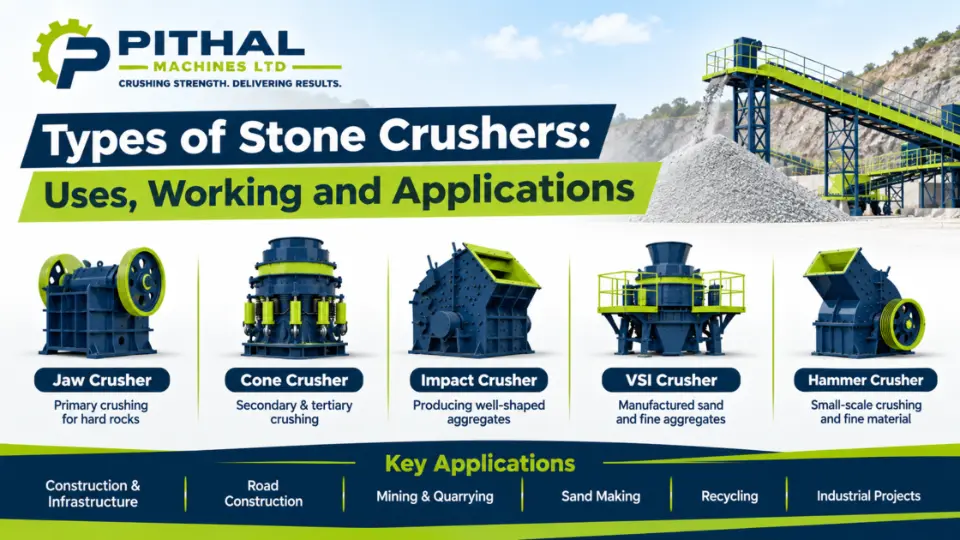
1. Jaw Crusher
A jaw crusher is commonly used at the beginning of a stone crushing process. Its main purpose is to break large rocks into smaller pieces that can be handled by other machines.
It has two strong metal plates called jaws. One remains fixed, while the other moves back and forth. When a rock enters the space between them, it gets compressed until it breaks.
Jaw crushers are widely used for hard stones such as granite and basalt. You will commonly find them in quarries, mining operations and road construction projects.
Common applications: Primary crushing, quarrying, mining and reducing large rocks before secondary crushing.
2. Cone Crusher
After the first stage of crushing, the material may still be too large for its intended use. A cone crusher helps reduce it further.
The machine has a moving cone inside a fixed outer shell. As the cone moves, it presses the stones against the outer surface and breaks them into smaller pieces.
Cone crushers are often used for hard and abrasive materials. They are particularly useful in plants that need consistent aggregate sizes for construction work.
Common applications: Secondary and tertiary crushing, granite and basalt processing and aggregate production.
A cone crusher generally works alongside a primary crusher rather than replacing it.
3. Impact Crusher
An impact crusher breaks stones by striking them with rapidly moving parts. Instead of depending mainly on compression, it uses repeated impact to reduce the material.
When stones enter the crushing chamber, rotating impact elements hit them and break them into smaller pieces. This method can also help produce aggregates with a more suitable shape.
Impact crushers are often used for limestone and other suitable medium-hard materials. They can also be used in certain construction waste recycling operations.
Common applications: Limestone crushing, concrete recycling, aggregate production and secondary crushing.
The material's hardness and abrasiveness should be checked before selecting this machine, as they can affect wear and maintenance.
4. Vertical Shaft Impact (VSI) Crusher
A VSI crusher is useful when a project requires finer material or better-shaped aggregates. It is widely used in manufactured sand production.
The machine uses a high-speed rotor to throw stones against a rock-lined chamber or impact surfaces. The material breaks through repeated impact, producing smaller particles.
In M-Sand plants, a VSI crusher helps produce fine material with a more cubical particle shape. It is generally used after the larger rocks have already been reduced in size.
Common applications: M-Sand production, fine crushing, aggregate shaping and improving particle shape.
5. Gyratory Crusher
Gyratory crushers are designed for large-scale operations where a high volume of material needs to be processed. They are mainly used in mining and heavy industrial applications.
The machine has a central crushing head that moves inside a fixed outer shell. As rocks enter the chamber, they are compressed and broken into smaller pieces.
Because these machines are large and have high processing capacity, they are generally better suited to major mining projects than smaller crushing operations.
Common applications: Primary crushing in large mines, hard rock processing and high-capacity industrial plants.
6. Hammer Crusher
A hammer crusher uses rotating hammers to break material into smaller pieces. As the material enters the machine, the hammers strike it repeatedly until it reaches a suitable size.
These crushers are generally used for softer or moderately hard materials. Limestone and coal processing are common applications, although the right choice depends on the material's properties.
Common applications: Limestone crushing, coal processing and selected industrial material applications.
A hammer crusher may not be suitable for every hard or abrasive stone, so material testing and equipment selection are important.
7. Roll Crusher
A roll crusher uses two rotating rollers to reduce material size. Stones pass through the gap between the rollers and get crushed under pressure.
The gap can be adjusted to control the size of the output. This makes the machine useful for applications where a more controlled reduction in size is needed.
Roll crushers are commonly used for coal and certain minerals. They are generally more suitable for softer or moderately hard materials than highly abrasive rocks.
Common applications: Coal crushing, mineral processing and industrial size reduction.
How Does a Stone Crushing Plant Work?
A stone crushing plant usually combines several machines to process raw material. The exact arrangement depends on the type of stone and the final product required.
Primary Crushing
This is the first stage, where large rocks are broken into smaller pieces. Jaw crushers and gyratory crushers are commonly used for this work.
Secondary Crushing
The material from the primary crusher is reduced further. Cone crushers and impact crushers are often used at this stage to produce smaller aggregates.
Tertiary Crushing
Some applications require finer material or better-shaped aggregates. A VSI crusher may be used at this stage, particularly for M-Sand production.
Not every plant needs all three stages. A plant producing basic construction aggregates may have a simpler setup than one designed to manufacture sand.
How to Choose the Right Stone Crusher Machine
Buying a stone crusher is a significant investment. Before choosing one, it is worth understanding the actual requirements of your operation.
Start with the raw material. Granite, basalt and limestone do not behave in the same way during crushing. Hardness and abrasiveness affect which machine will perform well and how frequently its wear parts may need attention.
Decide the final product size. The machine needed to produce large road aggregates may be different from the one required for fine material or M-Sand. Be clear about the sizes your customers or project specifications require.
Check your production target. Consider how much material you need to process per hour. The crusher should be able to handle the expected workload without being unnecessarily oversized for the project.
Think about maintenance. Crushing machines work under demanding conditions. Check the availability of spare parts, servicing support and the ease of replacing worn components.
Consider the complete setup. A crushing plant needs more than crushers. Feeders regulate the supply of material, conveyors transport it between machines and vibrating screens separate aggregates by size. All these components need to work together.
What Affects Stone Crusher Machine Cost?
The stone crusher machine cost depends on the type of machine, its production capacity, technical specifications and the material it is designed to process.
A single crusher and a complete stone crushing plant will have different investment requirements. A complete setup may include crushers, feeders, conveyors and vibrating screens.
It is also important to account for installation, electricity, maintenance and replacement of wear parts. Looking at these expenses alongside the purchase price gives a more realistic idea of the investment required.
Stone Crushing Equipment Solutions from Pithal Machines
Selecting equipment becomes easier when the requirements of the plant are clear. The type of raw material, expected production and final aggregate size all influence the machines needed.
Pithal Machines offers equipment for crushing and screening applications, including jaw, cone, bucket and VSI crushers, vibrating screens and complete plants.
Whether you are planning a new crushing plant or looking to upgrade an existing operation, understanding your processing requirements is a sensible first step. Explore Pithal Machines to learn more about its stone crushing and screening equipment.
Conclusion
Choosing the right stone crusher is an important part of running an efficient crushing operation. Each machine has a specific purpose, whether it is breaking large rocks, reducing aggregate size or producing fine material for M-Sand. The best choice depends on the type of stone, required output size, production capacity and overall project requirements.
It is equally important to consider the complete crushing setup. Feeders, conveyors and vibrating screens work alongside crushers to keep material moving and separate aggregates into different sizes. Selecting compatible equipment can help maintain a smoother process, manage operating costs and support consistent production.
If you are planning a new crushing plant or upgrading an existing one, take time to understand your requirements before investing. Pithal Machines offers stone crushing and screening equipment, including jaw, cone, bucket and VSI crushers, vibrating screens and complete plants. Explore Pithal Machines to find suitable equipment for your project and take the next step towards building an efficient stone crushing operation.